
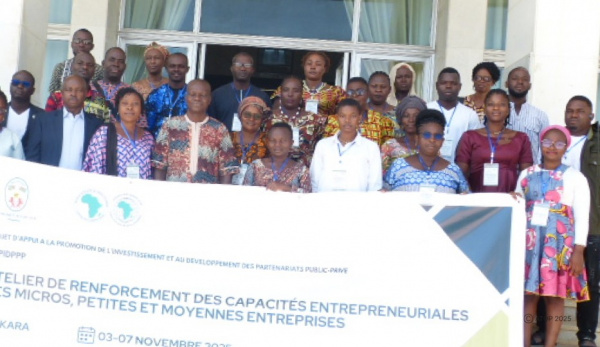
The Kara training workshop is bringing new momentum to the business community as entrepreneurs gather to learn, connect, and grow. Organized by the Ministry Delegate to the Ministry of Economy in charge of the Promotion of Investments, Industry, and Economic Sovereignty, this regional event is taking place in Kara until November 7. It focuses on strengthening micro, small, and medium enterprises that form the backbone of the region’s economy.
The workshop falls under the Project to Support the Promotion of Investments and the Development of Public-Private Partnerships, also known as PAPIDPPP. Its purpose goes beyond simple training sessions. It is designed to give artisans, traders, women entrepreneurs, business owners, and young innovators practical tools to organize their ventures effectively. With better structure, stronger competitiveness, and easier access to financing, these participants will gain the confidence needed to thrive in a demanding economic landscape.
This initiative arrives at a crucial time when regional economies seek stability and sustainable growth. For many participants, daily challenges such as limited credit, lack of technical support, and low visibility restrict expansion. The Kara training workshop helps address these challenges through practical lessons and interactive guidance that can reshape their business approach. Trainers and experts emphasize real-world application, ensuring that every session leads to measurable improvement in performance.
Equally important, the program fosters a spirit of collaboration among diverse business actors. By bringing together artisans, traders, and innovators under one roof, the event encourages shared learning and future partnerships. These exchanges often spark creative solutions that extend beyond individual ventures, strengthening the region’s collective entrepreneurial capacity. The Ministry’s involvement ensures that the support provided aligns with national economic objectives while addressing local realities.
Participants are also gaining insight into how public-private partnerships can unlock new opportunities. By understanding how to work with institutions and investors, they can scale their projects more strategically. The emphasis on financing is particularly relevant, as access to funds often determines whether ideas remain dreams or grow into successful enterprises. Through this initiative, many entrepreneurs are discovering new pathways to engage with financial systems that once seemed out of reach.
The atmosphere in Kara reflects both excitement and determination. Entrepreneurs exchange experiences, share challenges, and build networks that will continue beyond the workshop. Each conversation, each exercise, adds to a growing sense of empowerment that energizes the local business scene. The government’s decision to host such a targeted program confirms its commitment to inclusive economic development.
As the sessions progress, participants begin to see the tangible value of this experience. They leave with strategies to improve management, branding, and customer relations. They also gain motivation to innovate and adapt to changing market conditions. These outcomes collectively contribute to a stronger and more resilient regional economy that benefits every sector.
The Kara training workshop embodies the vision of progress through empowerment. It transforms ambition into action and connects personal growth with national development. By equipping small businesses with knowledge and access, it ensures that no potential remains untapped. As the workshop concludes, it leaves behind more than lessons—it leaves a renewed belief that growth begins where people are supported to succeed.