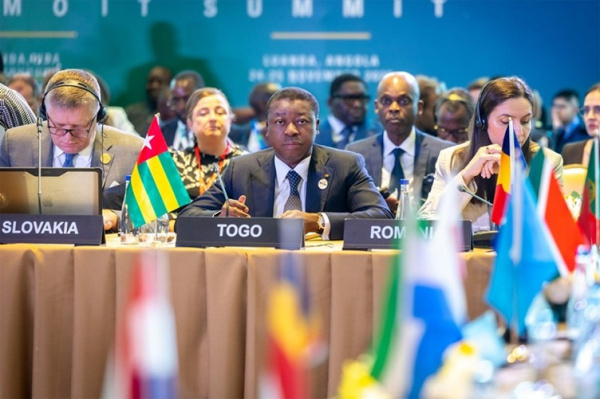
The Africa–Europe Partnership took center stage in Luanda as President Faure Gnassingbé renewed a powerful call for deeper cooperation between both continents. He delivered this message during the 7th Africa–Europe Summit, held on Monday, 24 November, and Tuesday, 25 November 2025. His address reflected rising concerns about global instability, shifting geopolitical pressures, and Africa’s growing need for stronger collaborative frameworks that support peace, stability, and sustainable development.
President Faure Gnassingbé highlighted the urgency of working together with clarity and commitment. He stressed that Africa and Europe must adopt a new style of cooperation anchored on mutual respect, shared responsibility, and long-term trust. Additionally, he noted that both continents face intertwined security, economic, and governance challenges that demand bold collective action rather than fragmented responses.
He structured his intervention around three major priorities that he believes should guide the next phase of Africa–Europe relations.
First, he emphasized peace as a global public good. He explained that peace no longer affects only national borders because threats travel faster across regions. Therefore, Africa and Europe must strengthen intelligence cooperation, coordinate early-warning systems, and deepen joint strategies that address terrorism, organized crime, and political instability. He stated that peace-building now requires inclusive partnerships, credible institutions, and stronger support for regional peace missions.
Second, he called for a renewal of multilateralism. He stressed that global institutions must evolve with new realities. They must also reflect current demographic, political, and economic shifts. He noted that Africa must occupy a stronger place in global decision-making spaces. He argued that inclusive multilateralism encourages fairness, improves policy coherence, and builds confidence among nations. Moreover, he urged both continents to defend global rules that support growth, cooperation, and democratic stability.
Third, he emphasized the construction of a common architecture of stability. This new framework would integrate political dialogue, economic investment, security coordination, and human development. He explained that Africa needs stronger infrastructure, modern digital systems, resilient health networks, and integrated markets. He stressed that Europe benefits when Africa grows stronger, more secure, and more competitive. Therefore, he encouraged both continents to treat development as a shared strategic interest rather than a one-way engagement.
President Gnassingbé also highlighted economic transformation as a key pillar of long-term stability. He noted that Africa’s youthful population offers unmatched potential for innovation, industry, and creativity. However, he stressed that this potential needs structured support through investment, skills development, and fair trade systems. He called for new financing models that empower African entrepreneurs, foster industrial growth, and strengthen regional value chains.
Furthermore, he encouraged Europe to expand investments in energy transition, transport networks, agriculture, and digital technologies. He stated that Africa needs reliable partnerships that create jobs, reduce poverty, and unlock inclusive prosperity. He also explained that sustainable development reduces insecurity, strengthens institutions, and builds societies that resist extremism and political violence.
As the summit progressed, his message gained strong attention because it reflected the concerns of many African leaders. They also seek balanced relations, stronger cooperation, and actionable outcomes that transform communities. His remarks highlighted the growing determination to reshape Africa–Europe engagement with clarity, fairness, and shared purpose.
President Faure Gnassingbé left Luanda with a renewed call for collective leadership. He insisted that both continents stand at a decisive moment. With deeper unity, stronger dialogue, and bold reforms, the Africa–Europe Partnership can build a safer, more stable, and more prosperous future for millions.