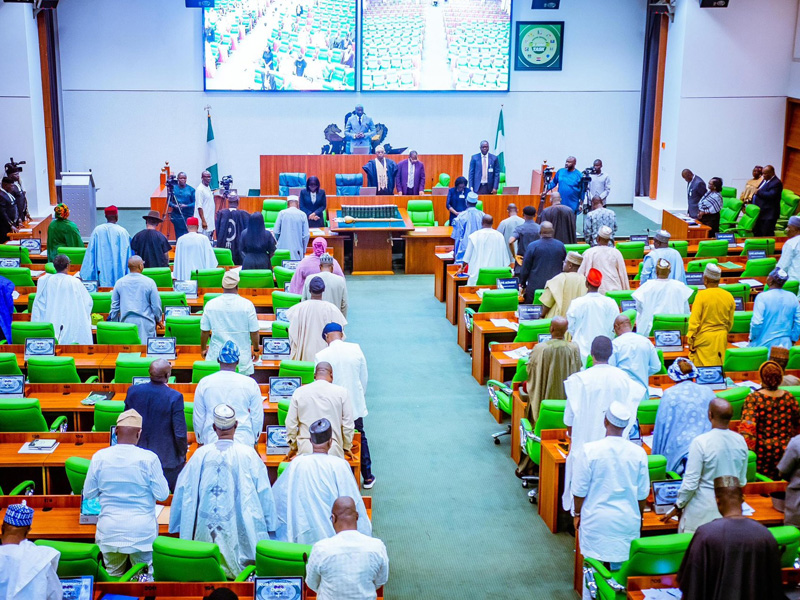
The House of Representatives has expressed concern over poor funding of the Office of the Auditor-General for the Federation (OAuGF), cautioning that continued financial neglect of the apex audit institution could worsen corruption and further erode accountability frameworks.
The alarm was raised by the House Committee on Public Accounts during its ongoing scrutiny of the 2026 budget proposal of the Auditor-General at the National Assembly.
In examining the proposed 2026 allocation of N15,881,134,488 to the OAuGF, the Committee noted that the sum amounted to about 0.027 per cent of the federal government’s N58.4 trillion total appropriation bill for the year.
Lawmakers described the allocation as grossly inadequate when weighed against the constitutional mandate of the Office, which is responsible for auditing more than 1,000 Ministries, Departments and Agencies (MDAs), in addition to other government-funded institutions.
The Chairman of the Committee, Hon. Bamidele Salam, argued that it was impractical to expect the Auditor-General’s Office to effectively oversee and audit a proposed N58.4 trillion expenditure with such limited financial support.
He revealed that budgetary limitations in previous years forced the Office to audit only five out of nearly 100 Nigerian foreign missions worldwide.
Salam also disclosed that in the 2025 fiscal year, just four per cent of the capital budget allocated to the Office was released, a situation that severely hampered its ability to function optimally.
An analysis of the 2026 proposed budget estimate showed that N5.3 billion was set aside for personnel costs, N5.6 billion for overhead expenses, and N4.8 billion for capital projects.
The Committee observed that without sufficient funding and the timely release of allocations particularly capital funds the Office would remain unable to deploy modern audit technologies, attract and retain skilled professionals, or significantly improve institutional efficiency.
Lawmakers pointed to global standards established by the International Organisation of Supreme Audit Institutions (INTOSAI), which stresses that supreme audit institutions must be provided with adequate, independent, and secure funding to discharge their duties free from external influence.
They further emphasised the need for budgetary autonomy, noting that audit institutions are best protected when they submit their budget proposals directly to the legislature or a designated parliamentary committee to preserve their independence.
According to the Committee, weakening oversight bodies through chronic underfunding ultimately compromises transparency and accountability in public financial management.
“This is associated with weak institutions, which have contributed to the corruption ravaging our country,” Salam stated.
Consequently, the House Committee called on the federal government and other relevant stakeholders to ensure adequate appropriation and full release of funds to the Office of the Auditor-General for the Federation, to strengthen its capacity to discharge its constitutional responsibilities and proactively curb corruption, waste, and mismanagement of public funds.
Juliet Akoje