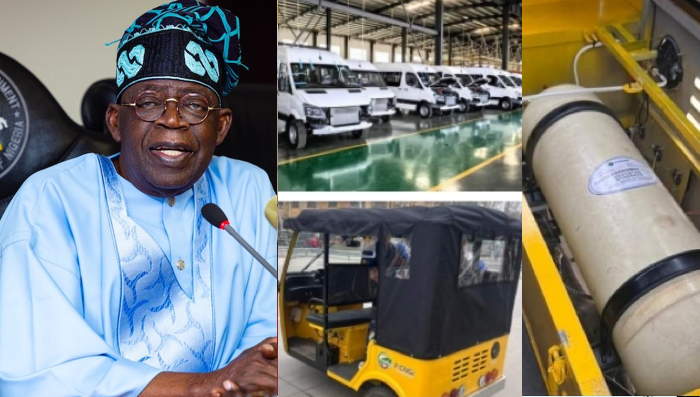
As Nigerians continue to groan under climbing fuel prices as a result of the Iran-US war, President Bola Tinubu Tuesday ordered the immediate deployment of 100,000 Compressed Natural Gas (CNG) conversion kits to ease the burden on motorists and reduce dependence on petrol.
It came as Abuja motorists are currently paying between N1,260 and N1,280 per litre of petrol, reflecting a noticeable variation across filling stations in the nation’s capital. The price range, which has remained recent days, is influenced by factors including global crude oil prices, distribution logistics, and demand fluctuations.
But commuters continued to feel the pinch as transportation costs adjusted in response to fuel prices, particularly in key cities where road traffic is heavy and daily commuting distances are significant.
However, President Bola Tinubu Tuesday took steps to cushion the harsh impact of the escalating Middle East conflict on Nigerian commuters by directing the immediate deployment of about 100,000 CNG conversion kits nationwide.
The order formed part of efforts by the government at the centre to reduce transportation costs and expand alternative energy options in response to the rising price of petrol and diesel triggered by the ongoing United States–Israel war with Iran.
Executive Chairman of the Presidential Initiative on Compressed Natural Gas (Pi-CNG), Ismaeel Ahmed, who made the President’s directive known to newsmen at the State House, Abuja, after a meeting with Tinubu said the President was keenly monitoring global developments and their impact on Nigeria’s energy costs, particularly the effect of the Middle East conflict on fuel prices and transportation.
According to him, the President has mandated the Pi-CNG initiative to accelerate the rollout of CNG infrastructure and alternative mobility solutions nationwide.
“The President, as usual, is always trying to get information on what is going on, especially with the war in the Middle East and the rising cost of petrol and diesel. He wanted to know what we are doing at Pi-CNG and EV to scale up the availability of gas and CNG everywhere in the country so that people would have less cost of transportation,” he added.
Ahmed explained that the kits, which will be distributed in collaboration with multiple stakeholders, will enable vehicle owners, including tricycle operators, to convert their engines to run on gas.
“So we have about 100,000 kits that we’re going to deploy in the next two to three weeks. The conversion centres will all be bustling with a lot of activities,” he said.
The Pi-CNG chairman added that the initiative will also fast-track the development of infrastructure for CNG refuelling and electric vehicle charging across the country.
According to him, the President specifically directed that infrastructure expansion should focus on key transportation corridors, particularly in the northern part of the country.
He explained that the government is already developing a network of refuelling stations and charging facilities to support the transition to gas-powered and electric vehicles. Ahmed disclosed that about 77 CNG refilling stations are currently at various stages of development nationwide.
He noted that several manufacturers have already indicated interest in setting up assembly lines in Nigeria, a move he said would boost job creation and strengthen the local automotive industry.
The Pi-CNG programme is also collaborating with the Rural Electrification Agency (REA) to deploy solar-powered charging stations, he said, that can support electric mobility, particularly in off-grid locations.
Similarly, the Dangote Refinery in response to the slump in global crude oil prices, has reduced its gantry price by N100 per litre. Currently, petrol pump prices in many parts of Lagos and its environ hover between N1,200 to N1,300. The situation has forced transporters to adjust their fares around the city upward while passengers, and other consumers buying petrol for their own uses at high costs are groaning over the new realities.
Brent, the global benchmark for crude oil prices, had hit $115 per barrel before slumping to $90 on Monday. The drop is expected to bring some relief in the area of petroleum products prices as responded by Dangote Refinery that has reduced its petrol gantry and coastal prices to N1,075 and N1,050.
In Lagos, THISDAY learnt that the price of petrol at many filling stations ranged between N1,200 and N1,300, with the exception of Total filling station on Bank Anthony Way, Ikeja, which sold the cheapest price at N1,149 per litre.
NNPC filling station on Governor Road, Ikotun and AP station along Idimu–Ikotun Road sold at the same price of N1,250 per litre. Petrocam at Ejigbo, sold at N1,200 while DB Petroleum on Ikotun–Ejigbo Road sold the highest price at N1,300. MRS filling station at the same axis sold at N1,,230 while NNPC at Egbeda bus–stop sold at N1,240
NIPCO at Dopemu, off Lagos–Abeokuta Expressway, sold at N1,244 while AP retail outlet on Oba Akran, Ikeja, sold at N1,234. The popular Northwest filling station at Maryland bus–stop was selling at N1,235 when THISDAY visited. Before now, petrol was selling cheaper, with the prices ranging between N809 and N835.
Similarly, the price of Automotive Gas Oil (diesel) has been reduced by Dangote to N1,430 per litre at the gantry, down from the previous N1,620 per litre. This represents a decrease of N190 per litre.
The refinery noted that these gantry prices do not include regulatory charges from the Nigerian Midstream and Downstream Petroleum Regulatory Authority (NMDPRA). Dangote Refinery had raised its gantry petrol price to N1,175 per litre — the third upward adjustment in seven days.
An industry analyst and Chief Executive Officer of Petroleumprice.com, Mr. Jeremiah Olagide told THISDAY that with the reduction of Dangote gantry and coastal prices, petrol pump prices may drop to between N1,110 and N1,120 in the coming days.
In Rivers state, the sudden hike in petrol pump price has made life uncomfortable for days. As of last Saturday, filling stations in Rivers State, especially in the Port Harcourt City, were selling a litre of fuel at about N800, but the price increased to between N1005 to N1095 by Sunday.
A visit to Restopark, NNPC, Nelly Valley, Peterkins, Conoil, and others within Port Harcourt showed that they were selling a litre of fuel between N1,255 and N1385. This development, it was observed, had created sudden hardship as commercial drivers within the state had increased their cost of transport.
In Kano, petrol was selling for N1,350 per litre, while the NNPC outlets were selling at N1,240 per litre. An official of the Independent Petroleum Marketers Association of Nigeria (IPMAN), who did not want to be named, attributed the price increase to supply and logistics challenges, as well as global oil price fluctuations.
Deji Elumoye, Emmanuel Addeh. Peter Uzoho, Ahmed Sorondinki and Blessing Ibunge