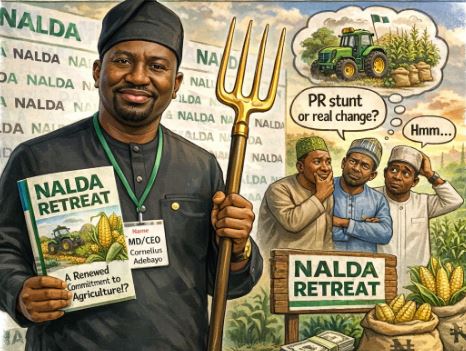
The National Agricultural Land Development Authority (NALDA) wrapped up a high‑profile strategy retreat this week aimed at boosting agricultural productivity and food sovereignty. Critics were quick to dismiss it as another photo‑op under CEO Cornelius Adebayo meetings, speeches and slide decks that may never translate into planted fields or cheaper food at the market. Given Nigeria’s recurring food shocks and the long list of failed programmes, that skepticism is understandable.
But before consigning NALDA’s latest push to the pile of well‑intentioned but hollow initiatives, it’s worth unpacking what happened at the retreat, what concrete steps the authority is proposing, and why this moment could mark a turning point — if the plans are implemented with urgency and transparency.
Why the headline scepticism rings true
- Too many retreats, too little harvest: Nigerian agriculture has seen repeated strategy meetings that fail to produce measurable results on the ground.
- Bureaucratic delays: Ambitious plans often stall in procurement, land disputes, or funding gaps.
- Political optics: High‑level retreats can be more about signalling than delivery, especially ahead of budget cycles or political seasons.
- Farmers’ distrust: Smallholders and local communities want seeds, inputs and market access now — not another plan that never reaches them.
What NALDA actually discussed — and why it matters
According to officials, Cornelius Adebayo framed the retreat as a practical road map rather than a talking shop. Key pillars discussed included:
- Land development and consolidation: Plans to unlock underused government and community lands for commercial and smallholder agriculture, with clearer titling and dispute resolution mechanisms.
- Input supply and mechanisation: Strategies to scale bulk procurement of seeds and fertiliser, and to expand tractor services and mechanised harvesting for medium‑scale farms.
- Value chains and agro‑processing: Proposals to link production to local processing hubs to reduce post‑harvest losses and add value within Nigeria rather than exporting raw produce.
- Market access and off‑take agreements: Plans to secure long‑term purchase agreements with local processors and institutional buyers to guarantee farmers’ incomes.
- Financing and private sector partnerships: A push for blended financing models that combine public funding, concessional loans and private investment to de‑risk agricultural projects.
- Climate‑resilient practices: Incorporating drought‑tolerant seeds, irrigation projects and soil restoration to protect productivity against weather shocks.
Concrete moves already underway
Beyond the buzzwords, NALDA under Cornelius Adebayo has signalled several practical efforts that suggest this retreat could lead to action:
- Land projects in pilot states: NALDA has identified pilot farm estates and land parcels in multiple states for immediate development, with plans to bring in mechanisation and input support for quick planting cycles.
- Partnerships with agri‑investors: The authority is reported to be negotiating memoranda of understanding with local agribusinesses and a few international partners to fund processing plants and storage facilities.
- Tractor and equipment leasing schemes: Trial leasing programmes for farm machinery aim to get mechanisation into the hands of cooperatives without crippling upfront costs.
- Linkages with off‑takers: Talks are underway with millers and food processors to sign offtake agreements that promise guaranteed markets for staple crops from NALDA‑supported farms.
- Focus on women and youth: The retreat included sessions on inclusion, with commitments to ensure women and young farmers gain access to land, training and small grants.
How this can avoid the usual fate of forgotten retreats
For sceptics to be convinced, NALDA must turn plans into verifiable action. Key safeguards that would change the narrative:
- Publish a clear implementation timeline: Which pilot farms will be operational by when, how many hectares will be developed, and when processing plants will be commissioned.
- Open procurement and transparent partnerships: Publicly disclose partners, funding sources and contract terms to avoid patronage and ensure value for money.
- Measurable targets and regular reporting: Commit to monthly or quarterly updates — hectares cultivated, tonnes harvested, jobs created, and number of women and youth reached.
- Local community inclusion: Ensure land development respects local land rights, provides fair compensation, and includes smallholders in ownership and profit‑sharing.
- Independent monitoring: Invite civil society, farmer unions and third‑party auditors to track progress and publish findings.
Why this NALDA retreat could matter now
Nigeria faces recurring food insecurity, import dependence for staples, and huge post‑harvest losses. NALDA has a unique mandate to convert idle land and fragmented smallholder production into coordinated, productive landscapes. If Cornelius Adebayo can move from strategy to delivery using pilots, transparent partnerships and measurable targets the authority could help lower food prices, create rural jobs and reduce the import bill.
Conclusion: Scepticism justified, but hope warranted
Yes, the headline cynicism is fair another strategy retreat easily looks like a PR exercise. But the content of this retreat and the concrete pilot actions NALDA is pursuing suggest there is potential for real impact.
The next test is simple: will fields be planted, harvests collected, and processing facilities running? If NALDA publishes clear timelines, opens its books, and delivers visible results in the coming planting seasons, the narrative can flip from “all talk” to “real harvest.” For now, Nigerians should watch closely and hold Cornelius Adebayo and NALDA to the measurable promises they just made.