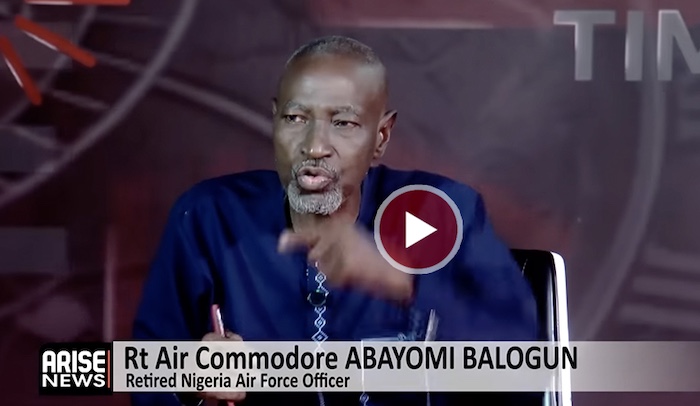
Retired Air Force officer and seasoned military fighter pilot, Air Commodore, Abayomi Balogun has raised concerns over Nigeria’s security situation, saying the armed forces remain handicapped and reactive, urging a shift to proactive, intelligence-driven operations to prevent attacks before they happen.
The seasoned air force officer said this in an interview with ARISE NEWS on Monday, following three separate Easter attacks in northern Nigeria.
“I sit down in disbelief to see that my Armed Forces, the Armed Forces I served, is today handicapped in a lot of ways. But I still believe that despite the handicap, we can still overcome if we choose to do the right thing at the right time. For me, right now, we are reactive. For a while, we have been reactive; we have not been proactive,” he said.
Adding, Air Commodore Balogun said: “How do you become proactive? It is when your operations are intelligence-driven. We must be able to get there before the enemy. You must be able to know the enemy, determine their intentions and their course of action, then you will take preventive and preemptive measures to prevent them from doing anything. But right now, we allow them to plan, we allow them to group until they attack us, then we respond. Even the response—we still don’t have that capability of quick response. You hear that these guys have come, they have attacked such and such a place, and they left into thin air. No. If we have the quick response squad which is air-mobile—those who are ready and always available to be deployed at short notice. When we were flying, we had alert phases. When we were at Alert Alpha, we were seated in the aircraft waiting for the ‘go.’ If there was anything, we were already seated in the aircraft and taking off. That is not being done now,” he noted.
Balogun advised that the armed forces work on leveraging technology and heavy intelligence, while also working with people in rural communities.
“That is the area I think we should work on: leverage technology and heavy intelligence. Where do we get this intelligence from? The grassroots. If we change the strategic approach, because right now we are doing top-to-bottom, we should start a bottoms-up approach.
“What does that mean? Where the people at the community become your first layer of defense. Without guns—they will not carry anything—but you must empower them to be able to “see something and say something.” Today we have that slogan, but the structure is not there. When they see something, who do they say that something to? You must be deliberate. You must create that structure and say: ‘When you see something, say it to this person.’”
Speaking on creating the intelligence structure, Rtd Air Force Officer Balogun explained that the center would be a single hub where all security agencies collaborate, analyze information instantly, and assign tasks without delay.
“What we need to do is to create an agency called the Multi-Agency Coordination and Control Center where all agencies are represented in a hall under one umbrella. The DSS is there, the Army, Navy—everybody is embedded in that hall so that when something happens, it is routed straight to that hall where the intelligence is analyzed and immediately passed to the end user. We saw two days ago how the Americans rescued those people. See the integration of resources to get that one man out of that place—just one. Are you saying we can’t do it? It just requires a little bit of seriousness and critical thinking,” he said.
On how to train and protect individuals who provide armed forces with information, Balogun underscored that retired military personnel could serve as trusted intermediaries, ensuring intelligence is reported safely and acted upon.
“If we are going electronically, if I video you now and send it to a WhatsApp group that I belong to, who knows? Except those on that platform. This is where I will bring in veterans. You have your ex-soldiers, ex-policemen, retired civil servants who are all over Nigeria. They are elderly, they have experience. I call them ‘Nigeria’s Retired Assets.’ We spend so much money to train these people; the day they retire, they go back to their villages. They are there and they are willing. Create that structure to monitor these veterans so that when you need them, you can reach down to them. Today, we don’t have such a thing.”
Addressing ransom payments and tracking criminals, Air Commodore Balogun said the solution lies in creating dedicated think tanks across the military.
“We need to set up think tanks. People who will just sit down and think—not necessarily people in the service. There are people out there who are not bothered with anything in life anymore; they just sit down and think for you. When you are talking about tracking, you hear about bandits asking for machines. That machine is their death certificate. If you ask for two, I will give you 20, because those machines will be tracked. Wherever they go, we will see them. Why are we not doing it? I don’t know. We need people whose responsibility is just to think for the active guys. You need people whose life will just be thinking about national security and passing it to them to execute,” he advised.
Speaking on the drivers of insecurity, Balogun said that while socio-economic factors like unemployment and education gaps contribute, the core issue is a lack of coordinated, decisive action.
“We can’t declare a state of emergency for the whole nation because even the Armed Forces that will handle it doesn’t have the strength to do that. While we are doing the kinetic means, we must also do the non-kinetic; they must go together. But the state we are in now, we have passed all this level—we have to take bold steps. We have to be audacious. There are few bad people; we can become a terror to them so that the good people can live well,” he stressed.
Favour Odima