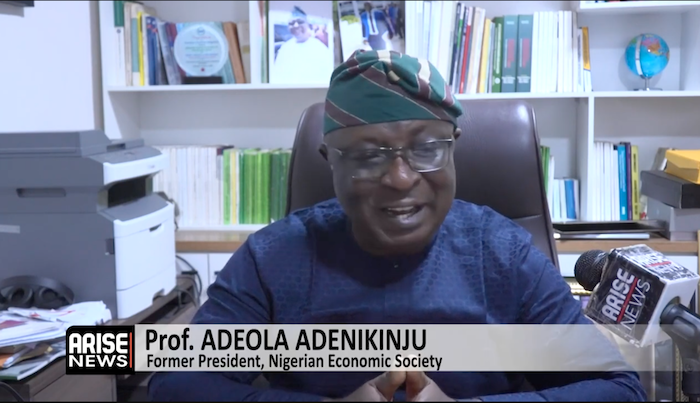
The immediate past president of the Nigerian Economic Society, and a Professor of Economics at the University of Ibadan, Professor Adeola Adenikinju has said that in spite of official data, Nigerians are still unable to afford basic needs as prices skyrocket.
The Professor said this in an interview with ARISE NEWS on Tuesday.
“Nigerians are facing very stiff increases in prices over time.
Unfortunately, the crisis we have is that of affordability. People can no longer afford the prices of the commodities that they need every day. So, the lives of Nigerians have not changed in spite of what the data is showing. Data shows that prices are not rising as they used to be”, he said.
Adding, Prof. Adenikinju said: “I think it’s important to note that the inflation rate is measuring one thing, and then what you see with prices is also another thing. What inflation is measuring is the rate of change in prices; it’s not saying that prices are coming down or that prices are reversing.”
Explaining further, he noted that a lower inflation rate doesn’t automatically make goods cheaper.
“If you look at January 2025, food inflation was about 29%. In January 2026, it has come down to about 9%. It’s not to say that the prices of food have come down. Yes, you may have the price of some food items coming down, but on average, prices have increased over time; it’s simply that the rate of that increase has declined”, he explained.
He maintained that even though overall economic indicators or inflation rates look better, the everyday reality for most Nigerians has not improved much.
“Like I said, what the average Nigerian is facing every day isn’t just the food they buy. They have to contend with transportation fares, which remain very high; they have to contend with paying for their rent, which remains very high and is not coming down. There are other items they still have to buy that are not coming down, and basically, the economic environment is still very difficult for the average worker. Yes, it is true that the macroeconomic environment is improving and stabilizing, but in terms of how it percolates down to the average Nigerian, we still have a very long way to go.”
He added: “Another example you can look at is small and medium-scale enterprises. Look at the cost of credit and the cost of energy. Electricity supply has gone down, so people have to spend more on generators or install solar. In spite of the Monetary Policy Committee reducing the MPR, (Monetary Policy Rate) at the last meeting, the cost of credit remains very high. So, when you look at the environment in totality, it is still very, very difficult. That is what the average Nigerian is experiencing, and that is why they are talking about things being difficult in spite of the fact that the inflation rate seems to be coming down.”
Prof. Adenikinju reiterated that average Nigerians’ real incomes remain low, limiting what they can afford despite macroeconomic stability.
“The fact really is that the economic conditions and the real income of average Nigerians are very low. In terms of affordability, what they can purchase with their real income has fallen as prices have gone up. You find that manufacturers are simply responding to this declining real income and purchasing power of Nigerians. People can no longer afford to buy items in the quantities they used to. Now, the manufacturers or producers are responding by creating items at smaller values that average Nigerians can buy”, he said.
He further explained that government policies must now focus on stronger growth to raise incomes and improve welfare.
“We must find a way, and government policies must move to the second level. We have stabilized the macroeconomy now; the exchange rate is stabilized, the price of energy is fairly stable, and the rest of them. But Nigerians are not feeling those impacts. Government must now move to the second level to ensure that the benefits of this stability are felt at the lower level by ensuring we have consistent growth in the economy—growth that is higher than where we are now.
“We are growing at an average of about 4% or thereabouts. We need to grow substantially higher than that before we start seeing the welfare level and the average income level of Nigerians rise to the level we expect as Nigerians”, he concluded.
Favour Odima