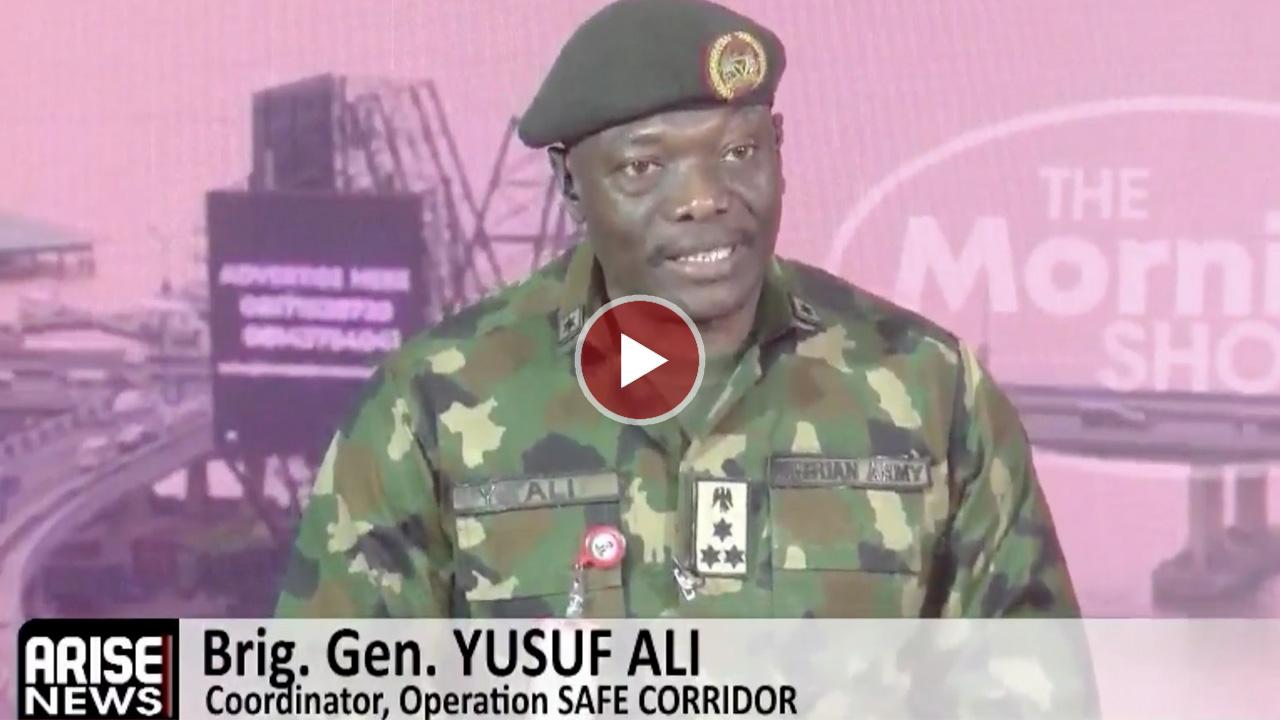
The Coordinator of Operation SAFE CORRIDOR, Brigadier General Yusuf Ali, has defended Nigeria’s deradicalisation and reintegration programme, insisting that there is no evidence that individuals who passed through the scheme have returned to criminal or terrorist activities.
Speaking in an interview with Wednesday during an interview on ARISE News, Brig. Gen. Ali said concerns that rehabilitated ex-insurgents were rejoining violent groups “do not reflect reality on the ground,” adding that the programme remains structured, transparent, and jointly supervised by multiple security and civil institutions.
Responding to questions about the effectiveness of Operation SAFE CORRIDOR and allegations that reintegrated persons sometimes relapse into crime, he said:
“The reality on the ground does not support that assertion. Operation SAFE CORRIDOR is structured and a well-developed system of screening clients and providing psychosocial and other forms of support we provide for them.
“At the end of their training at the DDR camp, we don’t just insert them into society like that. Their integration is even done by the various state governments. We only provide the environment conducive for them to be reintegrated into their communities.”
He explained that reintegration is not handled solely by the military, but involves state governments, traditional rulers, local leaders, and security agencies, who continue monitoring participants after release.
“From there, the state governments, traditional rulers, and other key leaders, including security agencies at the local level, continue the monitoring of the clients, ensuring that their behaviours are consistent with the training they have imbibed at Operation Safe Corridor,” he said.
Brig. Gen. Ali further maintained that, based on available records, no confirmed case exists of a deradicalised participant returning to violent crime across Nigeria or neighbouring countries.
“I am bold to say that no member of clients that have left Operation Safe Corridor has been found to foment trouble in their various communities, cutting across Akwa Ibom in the south, Ebonyi in the southeast, down to the north and other parts of the country, including our neighbouring countries like Niger, Cameroon, Mali, Burkina Faso and others,” he stated.
On calls for more structured tracking and accountability, including monthly reports from communities and traditional rulers, Ali welcomed the suggestion, describing it as a constructive improvement.
“I think I would take this as a recommendation… Operation Safe Corridor is not a 100% foolproof, faultless entity. It’s a work in progress. We are transparent, accountable, and open to suggestions like this,” he said.
He added that while formal monthly reporting systems were not yet in place due to the absence of adverse reports, such proposals would be considered going forward.
The discussion also addressed concerns about the categorisation of surrendered individuals, particularly the distinction between “low-risk” and “high-risk” participants.
Ali clarified that Operation SAFE CORRIDOR does not automatically grant amnesty, stressing that the Ministry of Justice plays a central role in screening and classification.
“Operation Safe Corridor does not provide amnesty just because you surrender. It comprises 17 ministries, departments, and agencies, including the Ministry of Justice. It is the Ministry of Justice that screens and categorises those that surrender… It is those low risks that are handed over to Operation Safe Corridor that we admit and administer deradicalisation and psychosocial therapy to,” he said.
Addressing concerns that individuals involved in violent crimes could still be classified as low-risk, he noted that some participants had not directly participated in killings and, in some cases, were victims of abduction and coercion.
“Some of them have not even seen somebody killed in their life. Some of them are abducted and made to run errands, fetching water, firewood and going on different messages,” he explained.
On broader concerns about rising terrorism in Nigeria and the effectiveness of the programme, Brig. Gen. Ali acknowledged the complexity of the issue, describing terrorism as a global challenge requiring both military and non-military responses.
“Terrorism has been a global phenomenon, and the causes are broad and many. What Operation Safe Corridor seeks to do is to reduce recruitment of gullible Nigerians who are brainwashed and recruited into terrorism and other violent crimes,” he said.
He argued that Nigeria’s current security situation reflects combined kinetic and non-kinetic interventions.
“Relatively put together, what we are currently enjoying, despite some few incidences here and there, is the net product of the combination of kinetic and non-kinetic operations,” he stated.
Concluding, Brig. Gen. Ali urged Nigerians to support security agencies in tackling terrorism collectively.
“Terrorism thrives where there are various factors, and it takes the whole nation to defeat terrorism. I will urge Nigerians to join hands with the Chief of Defence Staff so that both kinetic and non-kinetic operations can provide the desired peace and security that Nigeria rightly deserves,” he concluded.
Boluwatife Enome