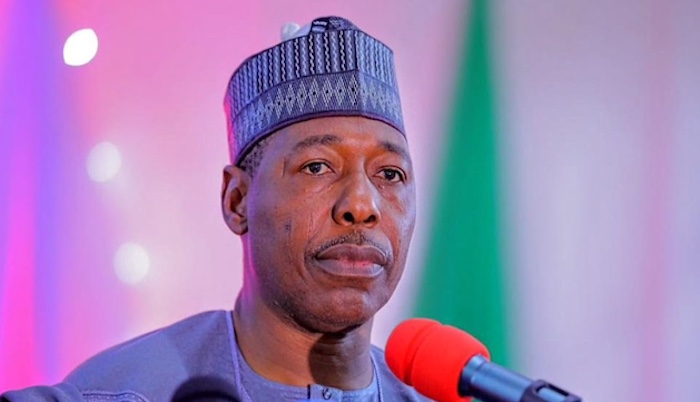
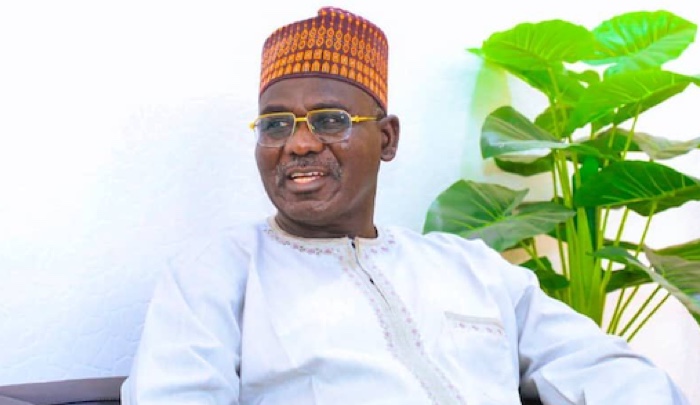
A former Chief of Army Staff, Lt. Gen. Tukur Baratai (rtd.), has called on the federal government to act against terror financiers, adding that the military alone cannot rout out insurgents.
Buratai said the mere identification of those financing terrorism would be insufficient to address Nigeria’s security challenges.
In March 2024, the federal government said it had uncovered 15 entities allegedly involved in terrorism financing, comprising nine individuals and six bureau de change (BDC) operators.
However, there has been little update from the government on efforts to prosecute the suspects, despite persistent public outcry.
Speaking during a television interview, Buratai said, “We over-rely on the military and the army; everybody has their own responsibility. You cannot say I should be responsible for naming the financiers of terror.
“The government knows where the source came from; we have responsible agencies. But it’s not just about mentioning names; action should be taken.”
The former army chief said the military’s role was limited to its constitutional responsibilities, adding that broader policy decisions, such as the rehabilitation of repentant insurgents, were determined by the government.
He described Nigeria’s insurgency as a complex and deeply rooted challenge that cannot be resolved quickly or through military force alone.
“Our focus has often been on the army, that the army must do everything: clear, dismantle, and wipe out all insurgents, but it is not like that. It is more or less an embedded problem within society, and it requires everyone’s effort,” he said.
“It would be wishful thinking for anyone to say that this type of insurgency can be cleared overnight. These are people with ideology and beliefs who think they have a mission. Once they establish it, they imagine a perfect society, which is not realistic in the Nigerian context.”
He also addressed the debate over the “technical defeat” of Boko Haram.
Buratai said that while the intensity of attacks significantly reduced after 2015 and territories were reclaimed, the threat persisted.
He recalled that at the height of the insurgency, bombings were widespread from Maiduguri to Abuja. Still, by late 2016, such attacks had largely subsided, and previously occupied local government areas were recovered.
Despite the gains, Buratai said he warned that insurgency could endure if not comprehensively addressed.
“At the time I was leaving office to take up an ambassadorial role, I warned that this was a cankerworm that could persist much longer than expected. I did not say this for attention, but because I understood that it is not just the military’s responsibility,” he said.
He cited ongoing challenges in parts of the North-east and North-west, including poor infrastructure, difficult terrain, and ungoverned spaces.
According to him, addressing insecurity requires sustained investment in development, including roads, rail, social services, and job creation, to tackle the root causes of instability.
Buratai further added that while the military had made progress and was not overwhelmed, it continued to face operational challenges, including a limited workforce and equipment relative to the vast terrain of the North-east.
“I don’t see that the insurgency is overwhelming the troops. We are okay, but we need more enablers such as drones and additional platforms. The landmass is enormous, and troops are widely dispersed,” he said.
The former army chief said lasting peace would depend not only on military operations but also on sustained government action, institutional coordination, and societal involvement in addressing the drivers of insurgency.
Chuks Okocha