
President of the Dangote Industries Limited (DIL), Aliko Dangote, on Wednesday maintained that Nigeria’s downstream regulator is still issuing licences for the importation of petrol despite public claims to the contrary, warning that the practice could undermine the operations of his refinery and jeopardiseNigeria’s energy security.
Dangote said the continued importation of refined petroleum products into Nigeria was hurting the petroleum refinery, which he insisted has the capacity to meet the country’s entire fuel demand.
Speaking exclusively with THISDAY, the billionaire businessman stated that although the refinery can produce up to 75 million litres of petrol daily, some market participants were still bringing in imported products into the country, a situation he said may ultimately affect the country’s energy security.
According to him, the persistence of import licences contradicts official assurances by the Nigerian Midstream and Downstream Petroleum Regulatory Authority (NMDPRA) that fuel importation would be limited once domestic refining capacity improves.
He added that while his refinery had begun exporting refined petroleum products to other markets, importers were still bringing fuel into Nigeria and engaging in practices that distort the domestic market.
“They are still issuing licences despite that we can meet the demand. They are still killing us with importation. They are importing and we are exporting. Yes, we can do 75 million litres, but they are still back-loading,” Dangote, Africa’s richest person told THISDAY.
Dangote was speaking against the backdrop of the downstream regulator saying that it had stopped issuing new licences for the importation of petrol because domestic refining is now meeting a significant share of Nigeria’s demand.
According to the regulator, the decision aligned with the provisions of the Petroleum Industry Act (PIA) which allows the issuance of fuel import licences only when local production is insufficient to meet national consumption.
The agency explained that no new petrol import licences were issued this 2026, as supply from domestic refineries, particularly the Dangote Petroleum Refinery, was considered adequate to support the local market.
But the statement contradicted NMDPRA’s latest data for January 2026, which showed that 24.8 million of imported petrol was consumed daily that month. However, in February, imported petrol consumed in Nigeria fell significantly to 3 million litres per day.
The NMDPRA maintained that import permits will only be reintroduced if there is a shortfall in domestic production, stressing that the policy is intended to strengthen local refining capacity and reduce Nigeria’s dependence on imported fuel.
But Dangote further alleged that many of the companies importing petrol into the country do not have retail outlets or filling stations, suggesting that some of the imported volumes were being diverted or smuggled after arriving in Nigeria.
The businessman warned that if the situation continues, it could replicate the challenges faced by local agricultural producers in Nigeria’s rice industry, where he said local farmers were undermined by unchecked imports.
“When they bring the goods, they smuggle them because they don’t have any filling stations. These importers don’t have filling stations. It’s affecting us. It’s the same thing they did with rice, they killed (the businesses of) every rice farmer. This is where we are,” stressing the need for job creation and energy security, rather than focusing on pricing.
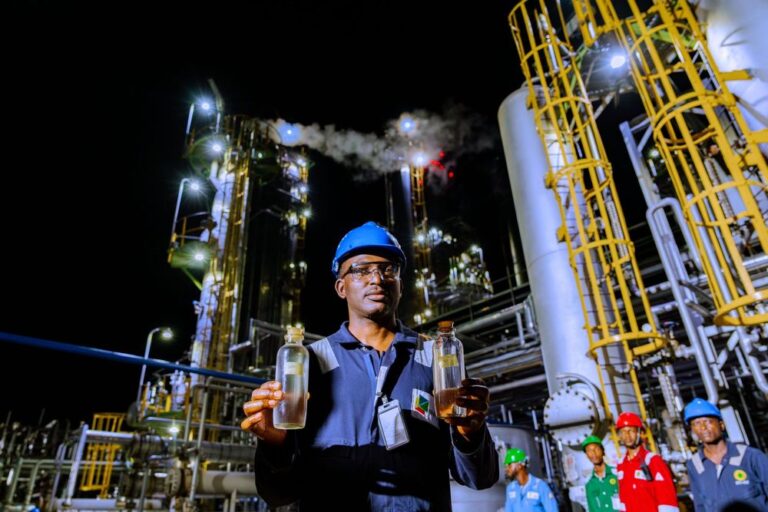
Nigeria’s fuel supply system has historically relied heavily on imports due to the poor performance of the country’s state-owned refineries. However, expectations have risen recently following the commencement of operations at the Dangote refinery, which has a nameplate capacity of 650,000 barrels per day, making it the largest single-train refinery in the world.
The facility is widely seen as central to Nigeria’s ambition to end its decades-long dependence on imported refined petroleum products.
Meanwhile, Nigeria’s Foreign Affairs Minister, Yusuf Tuggar, has argued that the Middle East conflict shows why Gulf oil and gas producers should regard Nigeria as a partner, not a rival, to help diversify supply during crises.
The remarks come as war in Iran disrupts shipments through the Strait of Hormuz, a corridor for about a fifth of global supply, forcing exporters to halt shipments and triggering price spikes.
Nigeria’s untapped reserves offer Gulf states an alternative source of crude and gas at a time when global flows are vulnerable and demand for hydrocarbons is set to remain strong for years, Tuggar told Reuters.
“It’s in line with what we’ve always advocated – that countries which might otherwise consider us competitors should partner with us and invest so they can diversify their market share, working with us,” he said.
Nigeria, long hampered by underinvestment, theft and pipeline vandalism, has lifted total output to about 1.7 million barrels per day from 1.4 million when President Bola Tinubu took office in 2023 and could grow further with new capital for fields and pipelines, Tuggar added.
Some analysts say US and Israeli strikes on Iran, and Tehran’s attacks on Gulf states, could prompt the region to defer African bets, but Tuggar said the opposite could also prove true.
“It could make them want to work with countries like Nigeria that are rich in gas and oil … to diversify market share for the benefit of both countries, or they could hold back.”
Nigeria and the United Arab Emirates signed a pact in January, the Comprehensive Economic Partnership Agreement, that Abuja says should unlock trade and investment. Qatar linked investors have also announced plans for investment in gas in Nigeria, though timelines remain unclear.
Tuggar said Nigeria has felt the pain of costlier oil because it imports large volumes of refined products, lifting transport and food prices, especially during the Muslim fasting month of Ramadan, when consumption typically rises.
But he said Nigeria was better placed to withstand longer term shocks as domestic refining expands.
The privately owned Dangote refinery says it is operating at name plate capacity of 650,000 barrels per day, enough to meet domestic needs. Oil will stay “relevant for many years to come,” Tuggar added.
“At the moment the world consumes about 105 to 106 million barrels per day. I don’t see that changing much anytime soon, so we need to work together so we have enough hydrocarbons available,” he said.
Emmanuel Addeh