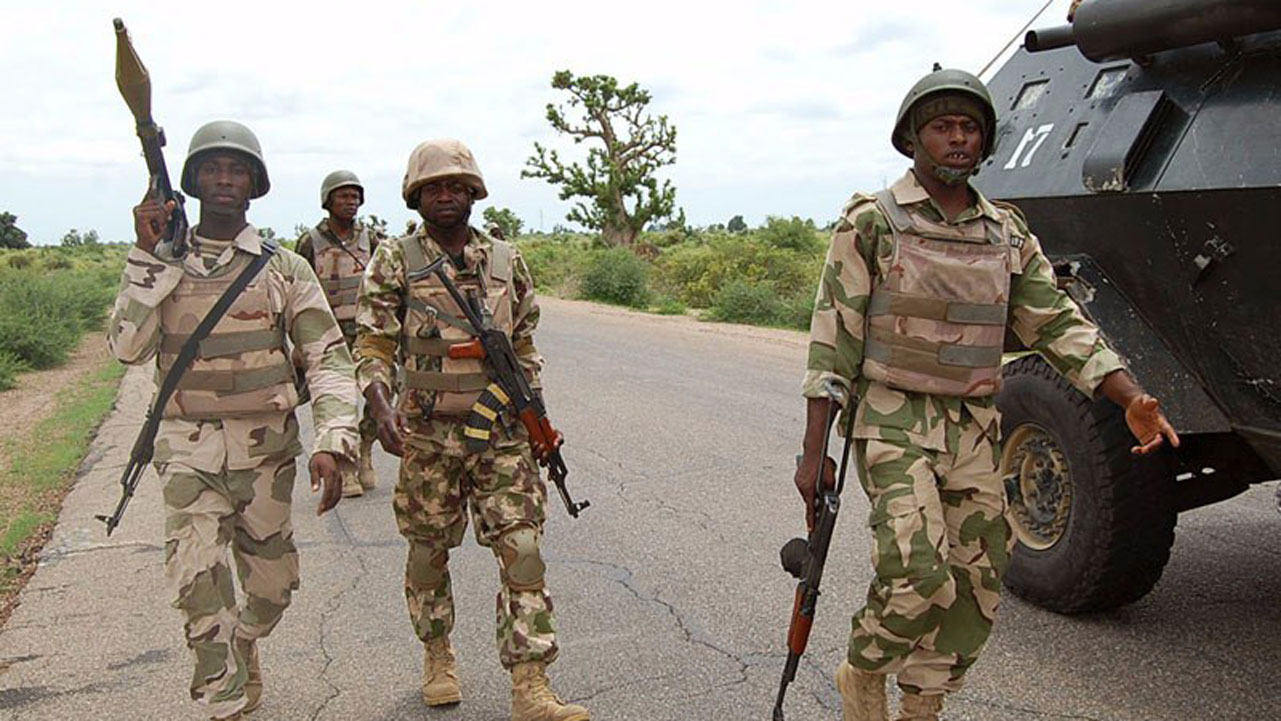

The federal government has said the United States and other global powers should play a supportive, rather than direct military intervention, in tackling insecurity in the country and the wider West African region.
Minister of Foreign Affairs, Yusuf Tuggar, made the position known during a discussion on regional security at the Chatham House in London, where he stressed that security challenges in Nigeria and the Sahel were best addressed through locally driven solutions backed by international support.
Tuggar said the Nigerian government was not opposed to cooperation with the United States and other major powers, including Russia, but maintained that external involvement should focus on providing equipment, intelligence and logistical backing instead of deploying troops on the ground.
According to him, Nigeria and other countries in the region had previously demonstrated the capacity to restore peace when given adequate support.
He emphasised that direct foreign military engagement in West Africa could complicate already fragile security dynamics in the region, describing the security environment as complex due to cross-border insurgencies, competing geopolitical interests and weak governance structures in border communities.
The minister pointed to earlier regional peacekeeping operations as evidence that West African-led security initiatives could deliver results.
He cited the role played by the Economic Community of West African States Monitoring Group (ECOMOG) during conflicts in Sierra Leone and Liberia, saying the interventions succeeded largely because they were driven by regional actors with international backing rather than direct external military control.
Asked what role the US should be playing, Tuggar said: “I would say an indirect role, a supportive role, as opposed to taking a more direct approach that would see perhaps boots on the ground and engagement because it’s a very complex region. What we need is support.
“Nigeria and other forces in the region have shown that with the right support, with the right equipment, we’re capable of restoring peace in our region. We’ve done it in the past. I mentioned Sierra Leone.
“I mentioned Liberia and what ECOMOG was able to achieve in the past. I think that is the best approach as opposed to a more direct approach, which becomes more complex,” the minister argued.
In late 2025, relations between Nigeria and the United States became briefly strained after US President Donald Trump publicly accused Nigeria of failing to stop attacks against Christian communities.
The remarks triggered a diplomatic exchange between Washington and Abuja over the framing of violence in Nigeria.
Amid the tension, the United States carried out airstrikes on suspected Islamic State-linked militant camps in north-west Nigeria on Christmas Day 2025, targeting locations in the Bauni Forest area of Sokoto State.
However, although the US president initially framed the strikes as action against militants responsible for attacks on Christians, the Nigerian government rejected that characterisation and emphasised that the operation was part of a joint counter-terrorism effort rather than unilateral American intervention.
Following the airstrikes, the United States deepened security coordination with Nigeria. The US Africa Command (AFRICOM) confirmed the deployment of a small team of US military personnel to Nigeria in early 2026 to assist with training, intelligence sharing and operational coordination against militant groups.
But Tuggar argued that the home-grown model should guide current efforts to address violent extremism across West Africa, particularly in areas around Lake Chad, where insurgent activities often cut across national borders.
The minister explained that security challenges in northern Nigeria were deeply interconnected with developments in neighbouring countries, making regional coordination essential.
Nigeria shares borders with Niger, Chad and Cameroon in the Lake Chad basin, creating a complex security landscape where militants frequently move across jurisdictions.
But because of this, Tuggar said security threats such as the insurgency by Boko Haram could not be effectively tackled by a single country acting alone.
The minister noted that the creation of the Multinational Joint Task Force (MNJTF) had previously improved cooperation among affected states, allowing security forces to pursue militants across borders and coordinate operations.
He said the effectiveness of the arrangement had been affected by changing political alignments in parts of the Sahel.
He said Nigeria was continuing diplomatic engagement with neighbouring countries to strengthen joint security responses, including efforts to deepen collaboration under the Accra Initiative, a regional security framework involving West African states.
According to him, discussions were ongoing to transform the Accra Initiative into a structure similar to the Multinational Joint Task Force in order to enhance coordinated operations against extremist groups.
Tuggar also stressed the importance of correctly framing the nature of insecurity in Nigeria and the wider region, cautioning against portraying the violence as purely religious.
While acknowledging that some attacks may have religious undertones, he said it was misleading to describe the situation as a Christian genocide.
“I’m not saying that the violence is not religious altogether. Some of it is motivated by religion, but it does not necessarily mean that there is a Christian genocide going on in Nigeria. That is false. It is incorrect,” he said.
He explained that insecurity in Nigeria involved a complex mix of insurgency, banditry, criminal violence and local conflicts, including disputes between farmers and herders.
He argued that oversimplifying the crisis as purely religious risked distorting the problem and undermining effective solutions.
The minister also linked regional instability partly to external geopolitical developments, including the aftermath of the Libyan Civil War, which he said contributed to the proliferation of weapons and armed groups across the Sahel.
He added that extremist organisations displaced from other parts of the world were increasingly relocating to fragile regions in West Africa, further complicating security challenges.
Ghana’s Minister of Foreign Affairs, Samuel Ablakwa, said terrorism in the region should not be interpreted solely through a religious lens.
He cited the killing of Ghanaian citizens by militants in neighbouring Burkina Faso, noting that the attackers did not target victims based on their religion.
Ablakwa said drivers of insecurity in West Africa included youth unemployment, climate change and state collapse in parts of the Sahel.
He maintained that the regional bloc Economic Community of West African States (ECOWAS) remained resilient despite the withdrawal of Mali, Burkina Faso and Niger, adding that Ghana was strengthening its defence capacity through increased spending and new technological capabilities.
“These terrorists didn’t ask them which religion they subscribed to. So, the point we are making is that we should be more nuanced…It is not just a simple, you know, religious matter,” he said, pointing out other drivers of violence including youth unemployment, climate change and state collapse.
“Terrorism taking root is a threat to the entire global community. The challenges we face today are direct consequences of certain actions by the international community, from Afghanistan to Syria to Libya…. not having a post-Gaddafi plan, how we deal with the regime change agenda in Libya. We’ve had to bear the brunt.
“What is going on now in the Middle East is going to further aggravate the situation. As you chase out the terrorists and dismantle those cells which you don’t want close to you, they will have to relocate… Should we allow Africa to be their safe haven?’’ he asked.