The Lagos State Government has again defended its demolition activities in Makoko and surrounding waterfront communities, insisting that the actions are driven by safety concerns and the need to protect human lives.
The defence comes in response to growing controversy over the displacement of residents and proposed relocation plans, following a recommendation by the Lagos State House of Assembly that affected communities including Makoko, Oko-Agbon and Sogunro be moved to Agbowa in Epe Local Government Area.
The Assembly’s position followed protests and petitions by residents after the state government, in December 2025, began demolishing what it described as “illicit structures” around the Third Mainland Bridge, leaving several people displaced.
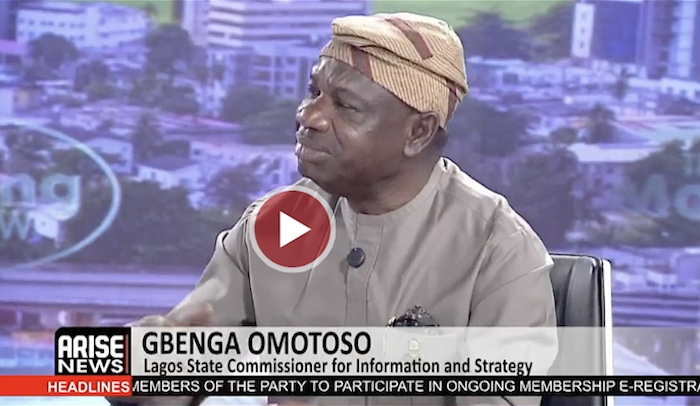
Speaking during an interview on ARISE News on Sunday, Lagos State Commissioner for Information and Strategy, Gbenga Omotoso, said the government’s priority is safeguarding lives, particularly for residents living under dangerous conditions.
“When you talk about life and livelihood, I do not understand why some people would like to choose livelihood over life,” he said.
Omotoso stressed that many of the affected structures were located under high tension electricity lines and near critical infrastructure, posing serious risks.
“It’s all about life, safety of life, security, and then not taking risks with human lives. The people are building on that electricity wire that should not even be close to human beings. And they’re building close to Third Mainland Bridge.”
He added that allowing residents to remain in such conditions could lead to disaster, warning that the same government would be blamed if tragedy struck.
“We leave these people there to stay under the high tension wire, God forbid something happens, the same government that is trying to resolve the matter today will be the ones that people will expect to carry the can.”
On the issue of relocation, Special Adviser to the Governor on e-GIS and Urban Renewal, Dr. Olajide Babatunde, explained that the government is pursuing multiple strategies, including redevelopment and possible resettlement.
“So what we have done… is to do a reorganization of the community by a design,” he said.
He outlined projects such as shoreline reclamation and the Water Cities initiative, which involves building floating houses, adding that lessons were drawn from countries like the Netherlands.
“The second option that we decided to embark upon was the Water Cities Project, which is actually building floating houses.”
Babatunde also pointed to the relocation of the Okobaba community as a precedent, noting that residents were moved to Agbowa and provided with housing at no cost.
“We’ve successfully moved them to Agbowa… we gave them houses for free, at no cost.”
Addressing concerns by Makoko residents, particularly fishermen who fear losing their livelihoods, Babatunde dismissed claims that relocation would disrupt their trade.
“You’re able to move from Lagos to Agbowa because they also have water there. And part of the fishermen have also moved to Agbowa. So it’s not correct that they cannot continue their trade in Agbowa.”
He further clarified that the demolition exercise was not a blanket action across Makoko but targeted at illegal and unsafe structures.
“Makoko is 51 hectares. It is intact. It is only the area where people have now encroached… that we’re talking about.”
According to him, affected residents had no legal approval to build in the areas cleared by the government.
“Those that are affected… they did not have approval to be there. They do not own the land.”
On compensation, Babatunde said the government is making provisions for displaced persons.
“So the compensation… is one of our strategies of taking care of those who are now displaced by the decision to remove them from the high tension.”
He added that the intervention was necessary to protect residents from danger.
“We needed to save them from themselves.”
While the Lagos Assembly has backed relocation as a long term solution, Babatunde noted that no timeline has been fixed.
“But we feel ultimately, Makoko should be relocated. But the assembly did not say when.”
The government also rejected claims that the demolitions reflect hostility towards residents, describing the exercise as part of a broader urban renewal strategy.
“It’s not that the government is wicked. What we are talking about is urban renewal,” Omotoso said.
Faridah Abdulkadiri