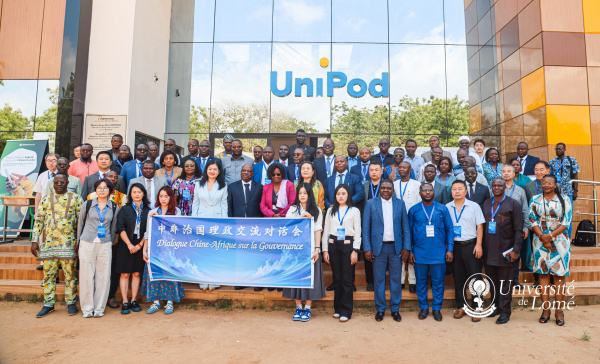
A renewed Global Governance Dialogue unfolded at the University of Lomé as it hosted the first China-Africa Dialogue on Governance on Monday, November 24 and Tuesday, November 25, 2025. The collaborative event, organised with support from the Chinese Embassy, created a dynamic platform for deeper engagement between African scholars and leading Chinese governance experts.
The gathering brought together around sixty participants, including fifteen senior experts from multiple Chinese institutions. Their presence added strong technical depth and widened the perspectives shared during the sessions. The discussions focused on governance reforms, development models, and the future of academic cooperation between China and Africa.
From the start, the conference set a vibrant tone. Delegates recognised that the Global Governance Dialogue emerged at a critical moment, as many African states seek new strategies for stability, growth, and institutional renewal. Therefore, the meeting offered valuable opportunities to compare governance experiences and explore new pathways for collaboration.
The first major theme examined prospects for cooperation linked to the fourth session of the 20th Central Committee of the Communist Party of China. The Chinese delegation outlined key ideas that can inspire stronger partnerships across infrastructure expansion, science innovation, and advanced technology. These areas remain central to Africa’s long-term transformation goals, especially as countries seek to modernise transport systems, accelerate industrialisation, and embrace digital development.
Additionally, participants explored the factors that shape successful governance reforms. China shared insights drawn from decades of rapid development, while African scholars highlighted strategies rooted in local values and national priorities. This exchange encouraged practical thinking, mutual respect, and shared learning. It also reinforced the belief that Africa’s development journey can advance through balanced cooperation rather than one-sided models.
The second theme centred on the Global Governance Initiative and its connection to the China-Togo comprehensive strategic partnership. Experts examined the initiative’s growing impact on global cooperation frameworks, especially in emerging economies. They noted that the initiative promotes inclusive decision-making, stronger multilateral systems, and development models shaped by fairness and shared responsibility.
Furthermore, the sessions highlighted strong areas of convergence between Beijing and Lomé. Both partners recognise the importance of security, institutional stability, and sustained development. They also value predictable multilateral processes and balanced global leadership. As a result, the dialogue strengthened their shared commitment to stable governance, peaceful societies, and coordinated regional strategies.
Participants emphasised that academic cooperation plays a vital role in shaping future policies. Universities can drive research, innovation, and leadership development. They can also help governments understand global trends and craft solutions that meet national aspirations. Consequently, the University of Lomé affirmed its readiness to deepen exchanges with Chinese institutions, enhance research networks, and expand student mobility.
The conference closed with renewed energy. Delegates celebrated the strong spirit of partnership displayed throughout the sessions. They also agreed that the ideas shared in Lomé will guide future projects, joint studies, and diplomatic engagements.
With purposeful cooperation, practical dialogue, and shared vision, China and Africa can build governance systems that encourage stability, prosperity, and global inclusion.