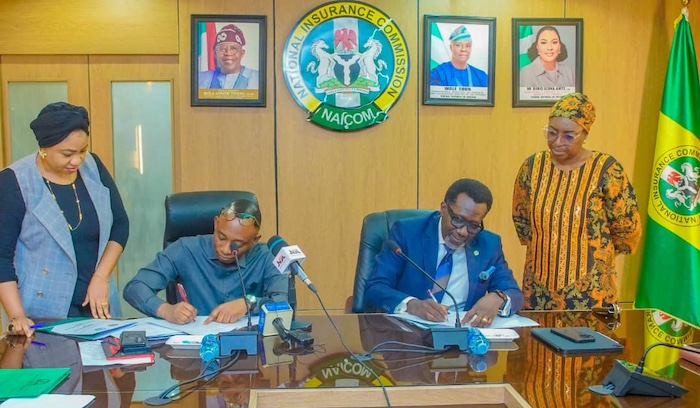
National Insurance Commission (NAICOM) has signed a Memorandum of Understanding (MoU) with Bureau of Public Procurement (BPP) to enhance collaboration and strengthen the insurance industry, particularly in relation to public procurement processes.
Commissioner for Insurance (CFI)/Chief Executive, NAICOM, Mr. Olusegun Omosehin, said the collaboration would reinforce the principles of public procurement and insurance practice in the country.
Speaking when he received Director-General of BPP, Adebowale Adedokun, on a working visit to the commission, culminating in the signing of the agreement, Omosehin stated that achieving President Bola Tinubu’s vision of transforming the country into a $1 trillion-dollar economy required strong inter-agency cooperation.
He stressed that the commission’s reform objectives could not be fully realised without strategic collaboration with agencies, such as BPP.
The commissioner disclosed plans to establish a platform to monitor and verify insurance coverage for public procurement items. He assured that insurance operators would strictly adhere to established rules and standards.
Omosehin stated that the signing of the MoU was a pivotal step in aligning the role of insurance with national development goals.
The MoU comes amid NAICOM’s ongoing reform following the Nigerian Insurance Industry Reform Act 2025.
The reform initiated a recapitalisation and verification exercise to strengthen the financial resilience of insurers, improve market confidence, and catalyse innovation and penetration.
BPP’s sector-specific procurement approach and digitalisationagenda complements NAICOM’s objectives by ensuring insurance procurement is transparent, efficient and aligned with national development priorities, including the Nigerian First policy and affirmative procurement for women, youth, start-ups, and persons with disabilities.
Omosehin highlighted the role of NAICOM as the statutory regulator charged with supervising, regulating, and promoting the growth of Nigeria’s insurance industry.
He stated that NAICOM’s current reform priorities included policyholder protection, regulatory capacity building, legal modernisation, recapitalisation, and increasing insurance penetration.
In his remarks, Adedokun, commended the transformation in the insurance industry, describing the commission’s environment as serene and reflective of its readiness to support the federal government’s economic growth agenda.
Adedokun welcomed the partnership and highlighted implementation as the critical next phase.
He said, “Signing MoU is only the beginning — what matters is delivery. BPP has moved to a fully digital submission model to speed approvals and reduce opportunities for corruption.”
He called on contractors and procuring entities to adopt insurance bonds to support Nigerian insurance sector growth and development, and comply with the Nigeria first policy and affirmative procurement principles of the current administration.
Adedokun reaffirmed BPP’s commitment to sector-specific procurement approaches that matched value for money and supported local industry development.
He reaffirmed that regulatory oversight rested with both NAICOM and BPP, ensuring transparency and accountability.
On capacity building, he recommended closer collaboration between both agencies and pledged BPP’s commitment to achieving shared goals.
Adedokun emphasised that under his leadership, BPP would not condone unethical practices or grant approvals to unqualified operators, urging insurance companies to ensure their inclusion in the BPP database for effective monitoring.
The MoU was formally signed by Omosehin, and Adedokun, marking a significant step towards enhanced regulatory synergy and sustainable growth in Nigeria’s insurance and public procurement sectors.
Essentially, the agreement formalises joint commitments to standardise and clarify insurance requirements across public procurement, including insurance bonds for public procurement; promote financial stability and consumer protection; use of insurance bonds to support local insurance market growth and increase local content in public contracts; as well as establish a joint technical working group and periodic retreats to monitor implementation, troubleshoot challenges and refine sector-specific procurement templates and guidelines.
The partnership marks a significant milestone in strengthening transparency, protecting public assets, and institutionalising robust risk management within Nigeria’s procurement system.
By embedding insurance more firmly into public procurement processes, the partnership enhances governance standards and builds greater confidence in government transactions.
James Emejo