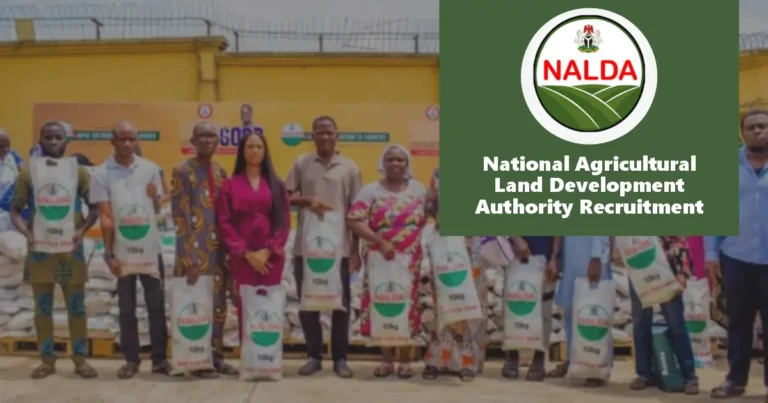

Nigeria’s agricultural challenge is no longer about potential. It is about execution. For decades, fertile land remained idle while food imports grew. Rural poverty deepened. Youth interest faded. Today, however, the National Agricultural Land Development Authority (NALDA) is steadily pushing back against that failure.
NALDA’s resurgence matters. It signals a shift from talk to action. It shows that agriculture can move beyond policy documents into real fields, real farms, and real livelihoods.
At its core, NALDA focuses on land. That focus is deliberate. Access to land remains one of the biggest barriers facing farmers. Without cleared and prepared land, productivity stalls. By stepping in to develop farmland, NALDA removes a major obstacle and accelerates cultivation.
Across several states, land development projects have begun to change local dynamics. Farmers no longer wait endlessly for support. Instead, they gain access to usable farmland within structured clusters. This approach improves coordination. It also reduces individual costs.
Equally important is mechanisation. NALDA understands that farming cannot rely solely on manual labour. Therefore, the agency continues to deploy tractors and modern equipment to farming communities. This intervention saves time. It increases output. It also improves efficiency.
As a result, farming becomes more attractive. Youth participation improves. Productivity rises. Income grows.
Beyond land and tools, NALDA’s emphasis on youth engagement deserves attention. For years, agriculture suffered from neglect among younger Nigerians. Many viewed it as outdated and unrewarding. NALDA is slowly changing that perception.
Through structured programmes, the agency presents agriculture as a business. Not charity. Not survival. Business.
This shift matters. When young people see value, innovation follows. Technology enters the space. Agribusiness expands. Rural economies gain new energy.
Food security remains another urgent concern. Rising food prices continue to strain households. Imports drain foreign exchange. In response, NALDA’s land expansion strategy directly boosts local production. More output reduces pressure on markets. Over time, stability improves.
In addition, the agency’s collaboration with state governments strengthens delivery. Agriculture is local by nature. Soil types differ. Climate varies. Community needs change. By working closely with states, NALDA adapts projects to real conditions rather than uniform assumptions.
Still, challenges persist. Funding gaps remain. Scale is not yet sufficient. Coordination across agencies requires improvement. However, progress should not be dismissed. Institutional rebuilding takes patience. What matters most is direction.
Transparency will define the next phase. Nigerians want clear results. Numbers matter. Hectares developed. Farmers supported. Jobs created. NALDA must continue to show impact in measurable terms.
Looking ahead, the agency has room to grow. Climate-smart farming, irrigation, and data-driven land mapping present new opportunities. With consistency, NALDA can help reposition agriculture as a pillar of economic resilience.
Ultimately, NALDA represents a quiet but important reset for Nigeria’s Agricultural Future. It reminds the nation that development starts from the ground up. Literally.
If sustained, focused, and accountable, NALDA can help transform idle land into productive wealth. Not overnight. But steadily. And that may be exactly what Nigeria needs now.