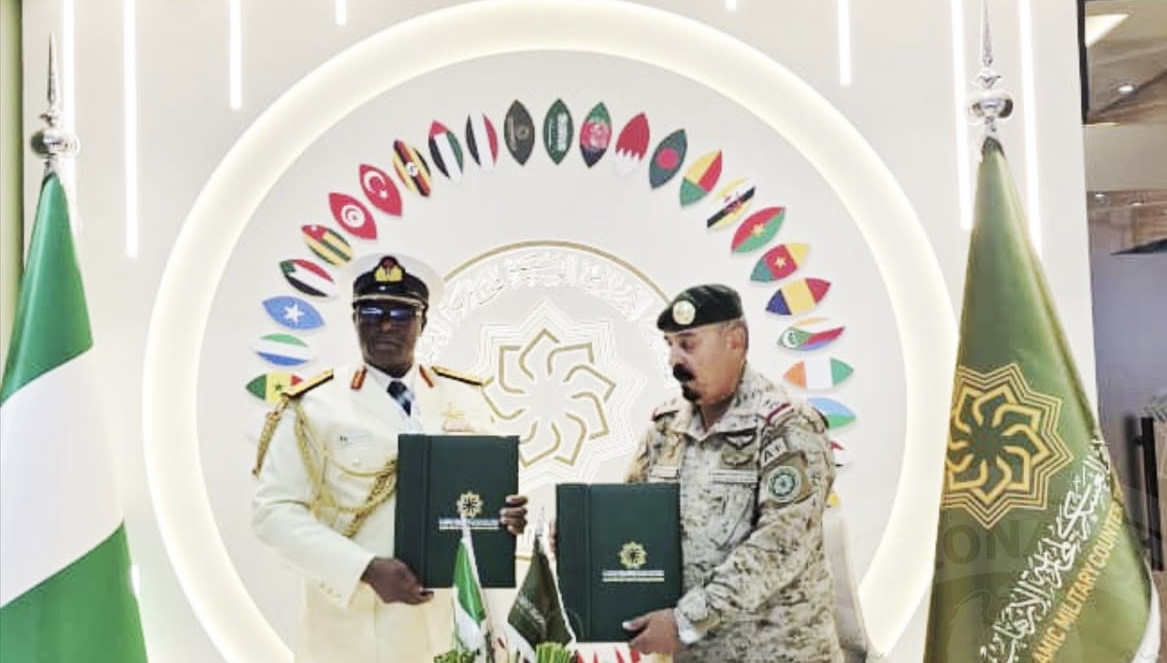
The National Counter Terrorism Centre (NCTC) and the Islamic Military Counter Terrorism Coalition (IMCTC) have formalised a landmark Memorandum of Understanding (MoU) aimed at strengthening bilateral and multilateral cooperation in counter-terrorism operations, intelligence sharing, and institutional capacity building. The agreement was signed on the sidelines of the World Defence Show 2026 in Riyadh, highlighting a shared commitment to coordinated global action against terrorism and violent extremism.
The partnership represents a strategic milestone for Nigeria’s counter-terrorism architecture. It also reinforces broader international collaboration against threats that increasingly transcend borders and regions.
Strengthening Operational Coordination
Under the new framework, both institutions will deepen operational cooperation through structured intelligence exchange, joint threat assessments, and coordinated response mechanisms. Terrorist networks often operate across multiple jurisdictions. Therefore, integrated intelligence and real-time information flow remain critical to prevention and disruption.
Officials from both organisations emphasised that the MoU will facilitate improved interoperability between national and coalition forces. Through harmonised procedures and shared situational awareness, security agencies can respond more swiftly and effectively to emerging threats.
The agreement also encourages joint simulation exercises and operational planning sessions. Such engagements will enhance preparedness and ensure that personnel operate under compatible doctrines and strategic assumptions.
Expanding Capacity Building and Training
Another core pillar of the MoU focuses on human capital development and institutional strengthening. Counter-terrorism increasingly demands specialised expertise in areas such as digital intelligence, financial tracking of extremist networks, border security, and counter-radicalisation strategies.
Through the partnership, NCTC personnel will access advanced training modules, technical support, and exposure to global best practices coordinated by IMCTC. At the same time, Nigerian operational experience in combating insurgency and asymmetric threats will contribute to coalition learning.
Both sides stressed that knowledge exchange must remain continuous rather than episodic. Therefore, the MoU establishes channels for sustained professional collaboration, research cooperation, and expert dialogue.
Enhancing Regional and Global Security
Nigeria’s participation in the IMCTC framework strengthens counter-terrorism coordination across West Africa and the broader Sahel region. Terrorist and extremist groups often exploit porous borders and fragile environments. Consequently, regional cooperation becomes essential for lasting security outcomes.
The agreement supports Nigeria’s ongoing efforts to degrade insurgent networks and prevent radicalisation. It also aligns with wider African and global initiatives that emphasise collective security approaches.
IMCTC representatives noted that partnerships with frontline states like Nigeria expand the coalition’s operational reach and situational understanding. Such collaboration improves global counter-terrorism response capacity and reinforces shared responsibility among nations.
Strategic Significance of the Riyadh Engagement
The signing at the World Defence Show underscores the growing convergence between defence diplomacy and security cooperation. International defence forums increasingly serve as platforms for operational partnerships rather than symbolic dialogue alone.
By concluding the MoU in Riyadh, both parties signaled readiness to translate policy alignment into concrete action. The engagement also demonstrates Nigeria’s proactive role in shaping international counter-terrorism collaboration frameworks.
Observers note that sustained partnerships remain essential as threats evolve toward cyber-enabled extremism, transnational financing, and decentralised recruitment networks. Therefore, institutional alliances such as this MoU provide continuity and adaptability in response strategies.
Toward a Coordinated Counter-Terrorism Future
The NCTC–IMCTC agreement ultimately reflects a shared vision of integrated global security cooperation. Through coordinated intelligence, joint training, and institutional alignment, both organisations aim to strengthen prevention, detection, and response capabilities.
For Nigeria, the partnership enhances national security resilience and supports ongoing stabilisation efforts. For the broader international community, it reinforces the principle that counter-terrorism effectiveness depends on cooperation, trust, and sustained engagement.
As implementation begins, both sides expect the MoU to translate into measurable operational outcomes. Enhanced readiness, improved intelligence flow, and stronger institutional capacity will define its success. In this way, the agreement advances a collective objective: a safer and more secure international environment built on partnership and shared commitment against terrorism.