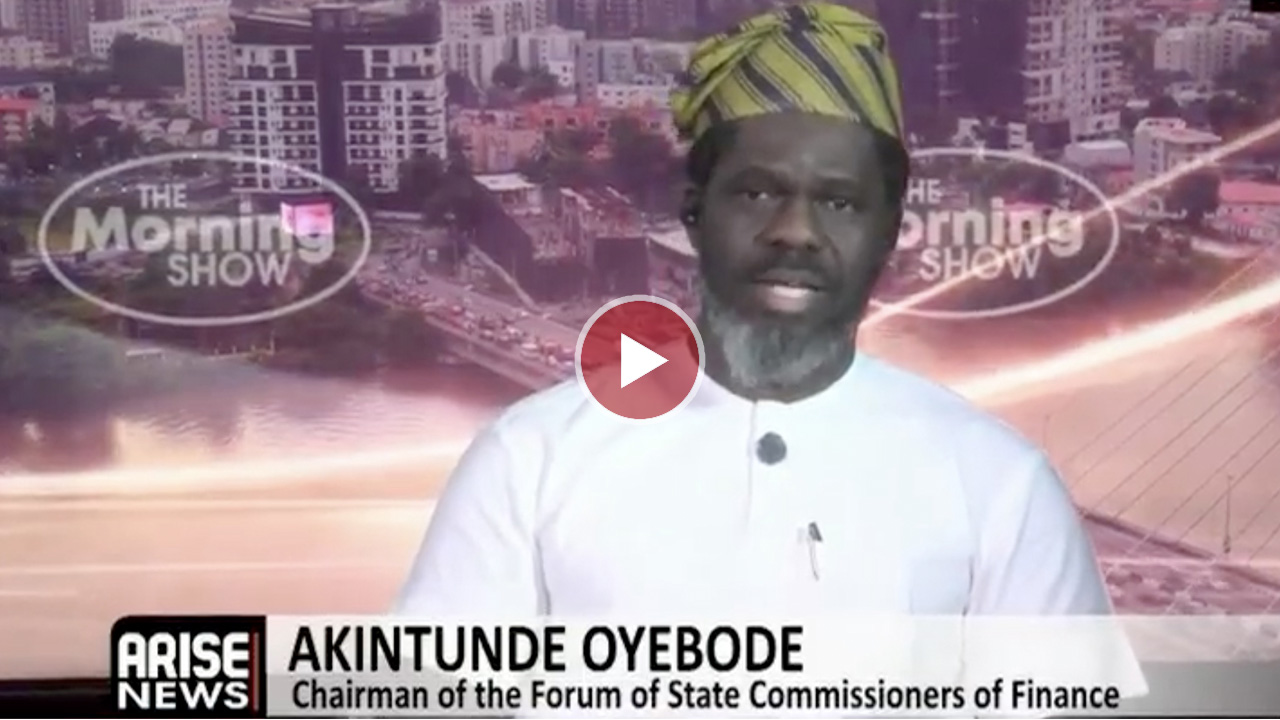
Chairman of the Forum of State Commissioners of Finance, Akintunde Oyebode, has said that the principle of upholding the constitution and protecting federal revenues must take precedence over short-term financial gains.
Speaking in an interview with Arise News on Tuesday, Oyebode highlighted the impact of the Petroleum Industry Act (PIA) on joint ventures (JVs) and stressed the need for proper governance in the management of national assets.
“If you look at the impact of PIA on JVs, which we are not talking about today, pre-PIA, JVs contributed circa 12 billion dollars to the federation. Post-PIA, that number has come down to about 2 billion dollars. So you do the math, that’s an area that no one is even talking about,” Oyebode said.
He criticised the transfer of JV assets without proper valuation or governance, noting that “we’re talking about just management fee and frontier exploration fees from PSEs, which contributes circa 1.5 trillion.
“Now NNPC, if we go by its audited financial statements, made a profit of 4.5 trillion in 2024. So if you look at the revenues of the corporation, what we’re talking about here is a small amount.
“So it’s not about the amount, it’s about the principle, it’s about the philosophy, it’s about the adherence to the constitution, it’s about safeguarding federation revenues. And I think that should be the focus. But also importantly, is that it’s about the evolution of NNPCL as a limited liability company.”
Oyebode also addressed concerns about potential executive overreach, saying that legal clarity should come from the courts.
“First, I think if you want a legal opinion, there are other bodies who you bring on your station who can provide a legal opinion. I’m not a lawyer, I’m an economist. But I think that at the heart of the matter is if there’s any legal concerns, the best thing to do is for the relevant parties to approach the courts for an interpretation,” he explained.
He reassured investors about the impact of the changes on investment climate, noting that the implementation committee overseeing the adjustments would protect contractual obligations. “Remember there’s an implementation committee.
“ So if, and it’s a big if, this tiny share of NNPCL’s revenues, again, I’m talking about 1.5 trillion, in a company that has declared revenues of 45 trillion, and profits of circa 4 trillion, or 4.5 trillion if I’m not mistaken. If that is an issue for their lenders, creditors, the implementation committee will ensure that if there are valid agreements, contracts in place, that it will not affect the repayment of those contracts.
“I imagine that the implementation committee will do that, and we should wait for their guidelines before coming to a conclusion. But as it affects the overall investment climate, I don’t think there’s any real effect.”
He pointed to recent growth in the oil and gas sector as a sign of confidence, citing new investments and projects coming online. “The oil and gas industry in this country has seen significant upsides in the last two years.
“We’re talking $10 billion of new investments. You know, we’re talking Bunga, Bunga North that’s gone through FID, UBETA, et cetera. Bunga Southwest is coming on board. I think it’s a great time for the industry as a whole.”
Oyebode also stressed the need for correct governance in handling federal revenues. “We need to act correctly as a country, right? A situation where an entity pledges assets that doesn’t belong to it, right, is also something that we can’t afford to continue into perpetuity.”
On state-level accountability, Oyebode emphasised that federal transfers are not gifts but legally mandated revenues. “Government keeps giving you guys so much. Good question. So I always like to correct the description of giving because it sounds like a charitable act.
“You know, these are revenues that belong to the Federation, right? And that should be distributed as prescribed by law. So no one is giving anybody anything.”
He highlighted improvements in transparency and fiscal management across states, referencing the impact of the World Bank-supported SIFTAS programme.
“Now, in my state, for example, starting from the budget process is very consultative. Up to the minutes of the budget consultation sessions, they’re available on the state website. Our budgets are published online.
“Procurement records are published online. Budget reports, quarterly implementation reports are published online. Audited financial statements are published online.
“And if you think about the aftermath of the World Bank-supported SIFTAS programme, many states are showing a lot more transparency and accountability when it comes to public finance.”
Responding to concerns about alleged mismanagement of state funds, Oyebode said, “I don’t hold brief for another state’s budget apart from mine. But I’ll tell you one thing.
“You have to ask yourself, is there an improvement between a private corporation, right? Whose budget, whose costs you don’t see, who’s not accountable to you. When these revenues go into the public purse, there is accountability. We’re talking about it now. That’s the first start.”
He also defended state healthcare budgets against criticism, citing significant investments in hospitals and primary healthcare facilities. “If you look across our budgets, we budgeted north of $3 billion for healthcare as a whole.
“What was reported as 68 million for a healthcare project in the state referred only to primary healthcare administration. Just last year, we renovated nine general hospitals, we’re constructing a ward at the State University Teaching Hospital, we renovated 125 primary healthcare centres, and built cold chain storage facilities.
“Can all of that be done with 62 million? It’s impossible. If you look at our budget and leave the social media banter aside, you’ll see that those numbers are even ridiculous.”
Finally, Oyebode addressed concerns about state borrowing and debt management. “Before you take a loan, there’s a borrowing plan that itemises what the loan is going to be used for. I struggle to see any state that’s really borrowing to fund its recurrent expenditure.
“A lot of the multilateral lending that you see is for things like providing water, support to agriculture, protecting the environment. These are clear programmes that provide potable water to citizens of the states.
“In our case, some lending has been to build an innovation, a knowledge zone, which is a commercially viable project. Between 2023 and 2026, subnational domestic borrowing has gone down significantly. The spike came in multilateral borrowing, and that is starting to moderate as the exchange rate moderates as well,”he concluded.
Boluwatife Enome