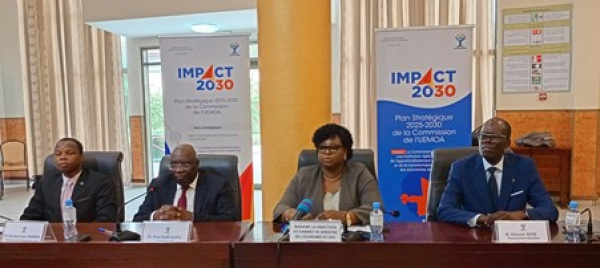
The Commission of the West African Economic and Monetary Union (UEMOA) initiated a session in Lomé on Thursday to promote two key strategic documents: the Prospective Vision 2040 and the Strategic Plan 2025-2030, known as IMPACT 2030. This effort is part of a sub-regional tour that will extend until March 21, 2025, across the member states.
Over the course of two days, representatives from various ministries, civil society, the private sector, and technical and financial partners convened to deliberate on these ambitious frameworks. Akou Mawussé Adétou Afidenyigba, Chief of Staff of the Ministry of Economy and Finance of Togo, emphasized that “the IMPACT 2030 plan outlines the primary directions for the Union in the upcoming years, featuring 12 key programs designed to enhance competitiveness, foster growth-oriented sectors, and encourage public-private investments and partnerships.”
See more: Umoa-Titles: Togo Seeks to Raise 15 Billion FCFA
Dr. Paul Koffi, the Commissioner for Enterprise Development, Mines, Energy, and the Digital Economy, emphasized that the goal is to transform the Commission into an “agile institution, a catalyst for enhancing integration and facilitating the structural transformation of the WAEMU economies.”
In addition, Vision 2040 aims to establish UEMOA as “a sustainably integrated, peaceful, and prosperous economic and monetary zone, open to Africa, with a strengthened strategic position globally.”
The strategic plan focuses on three primary ecosystems: the agro-industrial sector to ensure food sovereignty, light and extractive industries to promote formal employment, and value-added services to encourage innovation.
This plan is designed to sustainably transform the economies of the Union by focusing on five key areas: the development of production ecosystems, enhancement of economic infrastructure, promotion of human development, strengthening regional integration, and modernization of institutional governance.