
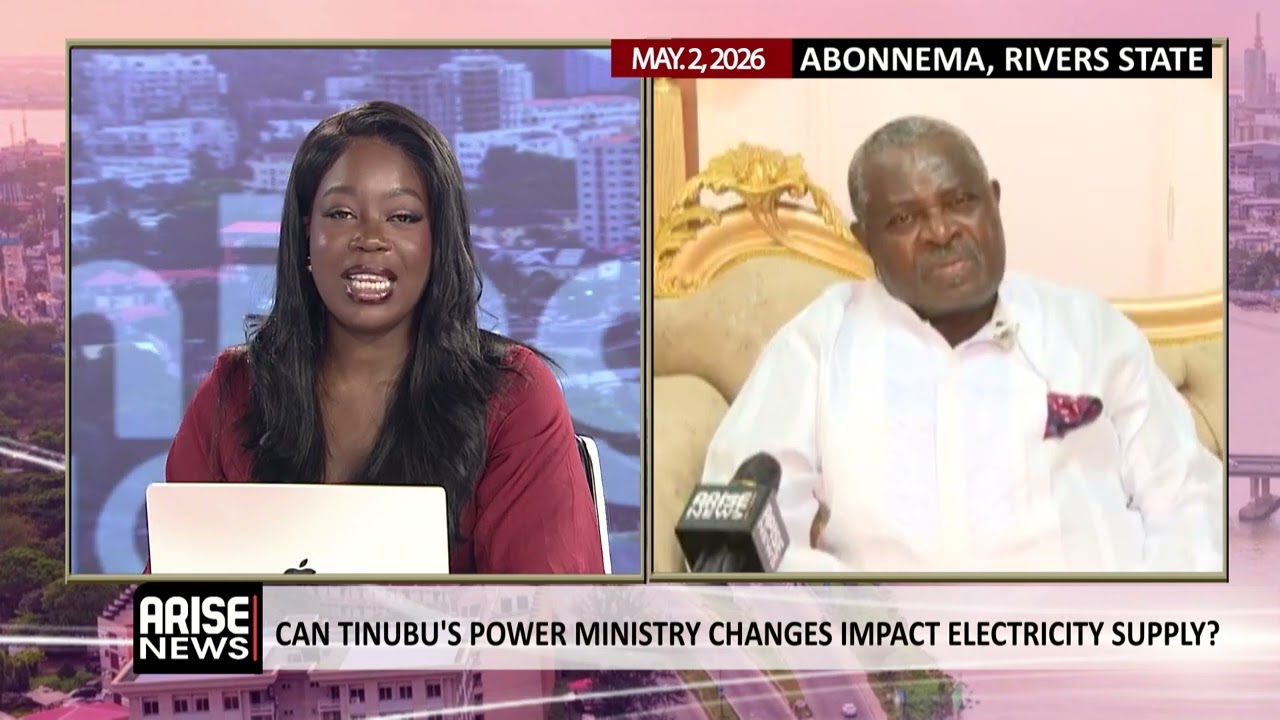

Former Chairman of the Presidential Taskforce on Power, Beks Dagogo-Jack, has described the Federal Government’s 90-day turnaround target for Nigeria’s electricity sector as unrealistic, saying the depth of deterioration makes such expectations “emotional at best.”
Speaking in an interview on ARISE News on Saturday, Dagogo-Jack said, “The deterioration in Nigeria’s power sector is so deep that talk of a 90-day turnaround is emotional at best; it will not happen. What we should expect, however, is a clear mission statement or directive that gives investors confidence, even more than it reassures Nigerians.”
He stressed that while immediate transformation is unlikely, clarity of direction within the timeframe could help mobilise much-needed investment into the sector.
“The power sector deterioration level is so deep that talking about a 90-day turnaround looks emotional at best. It will not happen. But if you are saying that in 90 days there should be some kind of mission statement, some kind of direction that will give confidence more to the investing community than even to Nigerians, because it is mobilisation that will change the story, then I can relate to that,” he said.
Dagogo-Jack, who served under former President Goodluck Jonathan, however commended President Bola Tinubu for initiating a reset of the power sector reform agenda, albeit belatedly.
“First, let me say that the president’s decision, it may look late, it is probably late to reset the power reform agenda, but it is commendable. We needed to do a reset and I am glad that the decision has been made,” he stated.
On the newly appointed officials, he expressed cautious optimism about their capacity to deliver.
“Looking at the appointees and the backgrounds they are coming from, one could even ask why not them in the first place on such a sensitive issue. I think the names suggest they can do the job,” he added.
He advised that both appointees must work in close coordination to avoid internal conflicts that could derail reforms.
“The two new appointees in the power sector must address these challenges with unity of purpose. They must be on the same page from day one, share responsibilities clearly and avoid territorial battles. Reform cannot survive in that kind of environment,” he said.
Dagogo-Jack also emphasised the importance of a comprehensive and honest assessment of the sector.
“They must carry out an intense diagnostic of what they met on the ground—very honest, very deliberate, very intentional. Without diagnostics, you cannot shape anything going forward. You need to understand where the problems are before designing solutions,” he noted.
He further called for the development of a credible reform model that would attract both local and international investors.
“For me, they must come up with a model on our problems and clearly present it—not just to Nigerians but to global experts. In trying to validate that model, you are already signalling seriousness and inviting investors to engage,” he said.
Highlighting structural weaknesses, Dagogo-Jack identified the distribution segment as the most fragile link in the electricity value chain.
“On the distribution sector, which is the weakest link, there has to be some form of reform to improve the health of the entire value chain,” he stated.
He also urged the Federal Government to support states in implementing the Electricity Act 2023, noting their limited experience in operating independent electricity markets.
“They must come up with a model to assist states in developing regional electricity markets. The states do not have the experience, so pilot programmes at federal and state levels will help others learn and replicate success,” he said.
Dismissing calls for quick fixes, Dagogo-Jack warned against the temptation of pursuing “low-hanging fruit” solutions.
“I really avoid rushing to a low-hanging fruit solution model because it is deceptive. This is structural deterioration and to fix it, you must go structural—and structure takes time,” he said.
He also cautioned against excessive reliance on public funds, advocating instead for private sector leadership.
“Investors cannot be stampeded, and I would not like the Federal Government to keep pushing treasury money into a sector that has capacity for private sector leadership and efficiency. It has never worked,” he added.
Dagogo-Jack reiterated the need for a clearly communicated roadmap to build public trust.
“Nigerians will be encouraged once they see where you are going. I have always said I did not see a roadmap. If this new team can show Nigerians a clear direction, people will be patient,” he said.
He noted that while long-term reforms take time, targeted technical interventions could yield short-term improvements.
“There are technical issues that can give quick recoveries because the experts know where the problems are. Fund those projects and deliver them. In 2010, we moved from under 2,000 megawatts to about 4,000 megawatts from existing investments. That kind of taskforce mentality can bring some immediate improvement,” he explained.
On gas supply, Dagogo-Jack stressed the need for better coordination across the energy sector.
“There should be stronger alignment on gas. The way the industry handles gas and the way the power sector uses it must be harmonised, and commercial issues must be resolved. Between gas and fixing distribution lies the long-term solution,” he said.
Addressing concerns over the State House’s shift to solar energy, he described it as a positive development rather than a cause for alarm.
“The State House going solar is not a bad signal. It shows that alternative energy is available. If it can work there, why not expand it to regions like the North-West and North-East with even better solar potential?” he said.
He added that such a move could ease pressure on the national grid.
“It actually frees up energy for others and reduces debt in the system, because many government institutions historically did not pay for electricity. So if they move off-grid, it leaves more power to be shared,” he explained.
Dagogo-Jack concluded that while expectations must be realistic, a well-coordinated reform strategy backed by investment and clear direction could gradually restore stability to Nigeria’s troubled power sector.
Boluwatife Enome