
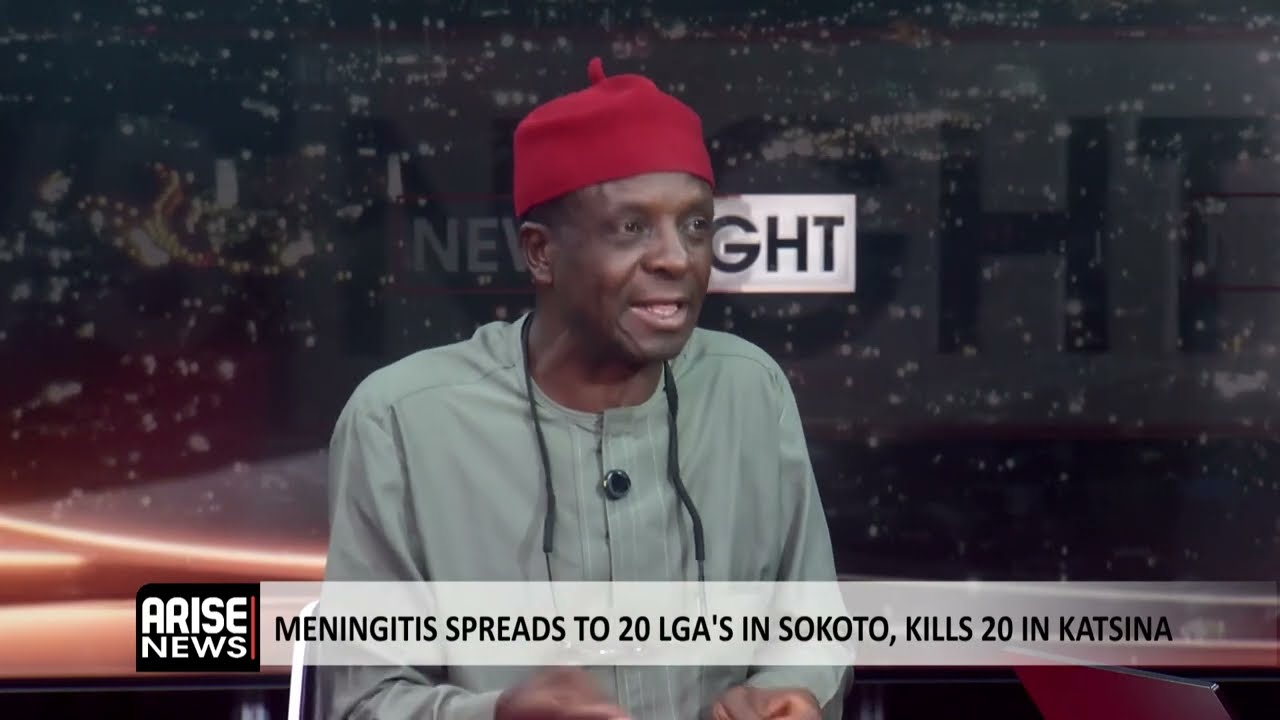
The Deputy Director of the Meningitis Technical Working Group at the Department of Planning, Research, and Statistics, Nigeria Centre for Disease Control and Prevention (NCDC), Dr. Eze Emmanuel has said meningitis cases in Nigeria are not rising, noting current figures are lower than previous seasons based on recent surveillance data.
Following a recent outbreak in Sokoto, Dr. Eze while speaking with ARISE NEWS on Friday said:
“Indeed, in the 2023–2024 season, by this time of year, we had recorded over 3,000 suspected cases cumulatively. In the immediate past season of 2024–2025, we had recorded close to 5,000 cases by this time, with Yobe State alone having over 1,000 suspected cases. This year, thankfully, the numbers are still below 1,000 cumulatively. Looking at that, we can say that cases are not actually increasing; they seem to have come down a little this current year.”
Dr. Emmanuel explained that vaccination remains the strongest tool against infectious diseases, but Nigeria continues to record deaths because the dominant strains of meningitis have changed over time.
“Vaccination is the most definitive response or intervention against vaccine-preventable or infectious diseases.
“Previously, the strain that caused the highest mortality and morbidity regarding bacterial meningitis was serotype A. That was back before 2014 or thereabouts; it used to dominate the outbreak space. Nigeria responded by introducing a vaccine against that strain called MenAfriVac. Over time, that serotype has gone down.

“The vaccine against serotype A was first introduced through campaigns and then routinized, meaning our children receive it as part of routine immunization in hospitals within the first five years of their lives. Major bacteria that cause meningitis—Streptococcus pneumoniae, Haemophilus influenzae type b, and Neisseria meningitidis serotype A—are all now in our routine vaccination.
“However, with climate change and emerging or re-emerging diseases, serotype C is now the dominant pathogen. In fact, if you look at our confirmations, over 90% of all confirmations are this serotype,. The dominant pathogen now is serotype C, along with a few cases of X and W.” he explained.
In a turn of events, the deputy director added that in response to this shift, a new pentavalent vaccine, Men5CV, has been developed to target five meningococcal strains and strengthen long-term prevention efforts.
“The global community, WHO, and Nigeria have come out with a pentavalent vaccine called Men5CV. It contains five antigens in one vaccine, targeting the A, C, W, Y, and X serotypes of the Neisseria meningitidis organism,” he shared.
On the effectiveness of the vaccine, Dr. Emmanuel said it has been effective so far, with current outbreaks mainly occurring in LGAs yet to receive vaccination coverage.
“We can say it is effective. If you look at the places where outbreaks are occurring now, they are occurring in Local Government Areas (LGAs) where these vaccines have not yet been deployed. They are occurring in other local governments that have not yet benefited from this vaccination,” he concluded.
Favour Odima