
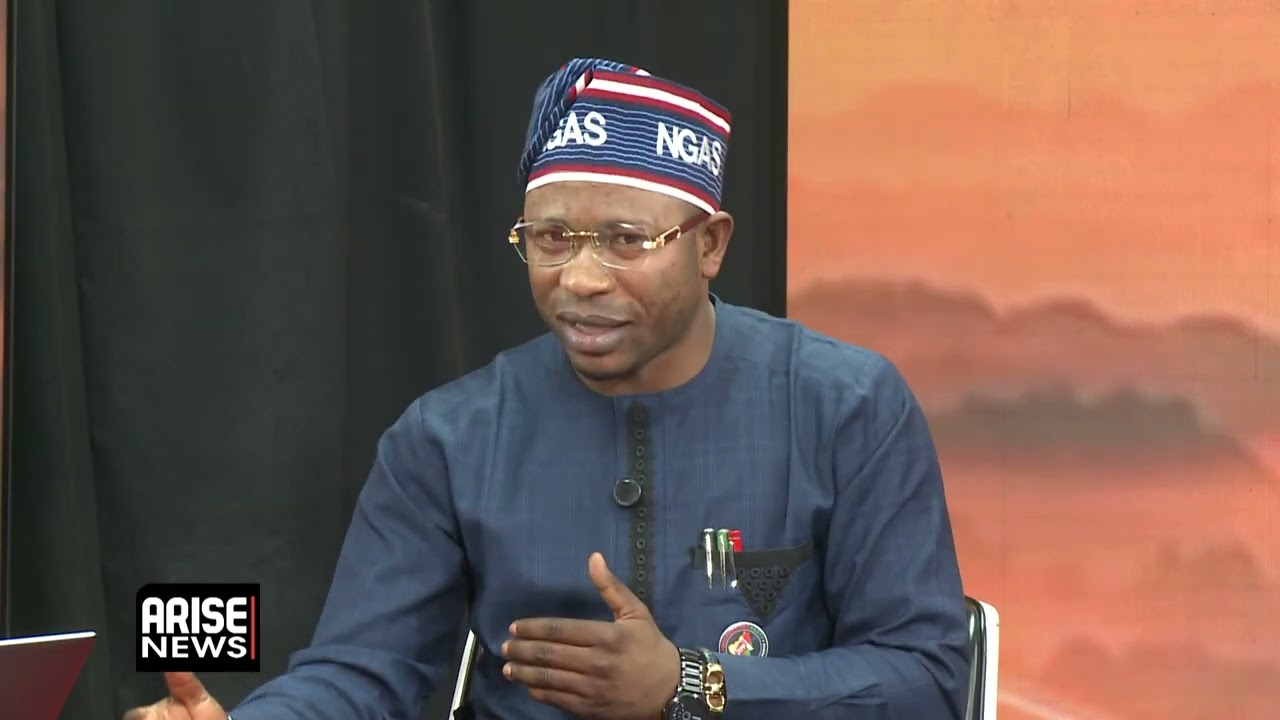

Former Speaker, Plateau House of Assembly and Political Scientist, Honourable Gabriel Dewan has defended the rotational arrangement in the Pankshin-Kanke-Kanam Federal Constituency, Plateau State, insisting that power should return to Pankshin after Kanam’s 12 consecutive years of representation in the National Assembly.
Following a protest on Thursday over the alleged “third term agenda” in the Pankshin-Kanke-Kanam (PKK), Federal Constituency, Plateau state, Hon. Dewan said the constituency’s longstanding rotational arrangement requires power to return to Pankshin.
He said this while discussing the PKK zoning crisis with ARISE NEWS on Friday in an interview.
“To start with, I am from a constituency that consists of three local governments: Pankshin, Kanke, and Kanam. Those three local governments make up the Federal Constituency of Pankshin-Kanke-Kanam, popularly known as PKK. Those from Kanam started protesting that it would be unfair for them to be marginalized for a Kanke man to have 12 straight years in the National Assembly while they only had four years. So, the power must shift to them. They came up with that argument and, of course, people of conscience within the constituency agreed with them.
“It is expected that now that Kanam has enjoyed 12 straight years, the power has to move back to Pankshin for Pankshin to have their own 12 years. Then it will move to Kanke so they have their own 12 years. Then Kanke will now begin the fourth round, just like Pankshin began the second round and Kanam began the third. Ideally, it has to go round so it ends in Kanke, so Kanke would also begin as the last people. Now, that is where the problem is,” he said.
Speaking more on the matter, Hon. Dewan explained that the rotational arrangement was designed to prevent marginalisation in the Pankshin-Kanke-Kanam Federal Constituency by ensuring that all ethnic and local government groups have a sense of belonging and fair representation.
“In a multifaceted constituency like PKK where we have three local governments, more than seven ethnic groups, and religious differences, the purpose of that rotational representation is to give every section a sense of belonging. I believe it is in that wisdom that our own parents, as of that early 1999, decided that if we allowed the constituency to go like that, there would be marginalization—meaning the majority tribe in that constituency would end up taking charge of the seat continuously.”
He also said his position is not about party interference but about leaders being consistent and accountable for their past statements.
“It’s not about Dewan. It’s not about me. There are many aspirants in the APC. All that some of us are saying is that as leaders, we should be responsible for our statements. You cannot say yesterday that PKK is a partnership—forgetting you have a constitutional right to contest—then today you come back and say the Constitution does not deprive you of the right to re-contest. All we are saying is that as leaders, you should be responsible for every statement you make. Don’t be manipulative by saying ‘yellow’ today and ‘red’ tomorrow just to manipulate the innocent electorate,” he stressed.
Speaking on the protest that held on Thursday, the lawmaker said the protests involved multiple groups and were a solidarity march on rotational representation, with some of his supporters involved.
“I was told that they were going to have a solidarity and awareness march by telling the people the implication of a third term. If you look at that protest very well, you see it’s a combination of different groups. There are groups tagged as ‘Anti-Third Term,’ there are groups tagged as ‘Jamlolok.’ I cannot distance myself from them because some of my own supporters partook in it. I cannot deny that. I’m not the leader that will come to national TV and start running away from responsibility. My own supporters, my own party men—some of them partook,” he admitted.
Responding to questions on whether any party is afraid of the ballot, Hon. Dewan said the issue is not about electoral fear but about fairness in maintaining the rotational arrangement that brought leaders into office.
“I cannot say the APC because, for now, they are up to like four or five that are contesting on the APC. I’m alone. And there are others in the PDP, others in the ADC. So, it’s not about even YPP and APC alone; it’s about the collective well-being of the federal constituency. What people are saying is: let the power move. Without minding whether it is YPP, APC, ADC, or PDP, the issue is: let the power leave Kanam for Pankshin.
“What we are saying here is: you have taken your shot. We’re only reminding him to wait. You rode on that process to be where you are, and you cannot cut the ladder you used to get where you are—because that is what you used to be there. Remember, I told you that if it was not because of that rotation that was advocated, he would not be there. I am bold to say that: he would not be there in the first instance,” Dewan insisted.
On whether the zoning controversy affects his ambition, the lawmaker said his political strength lies in his experience, electoral record, and role in promoting peace and unity in Plateau State, which he believes make him a strong contender.
“As the only person that won election in WYPP in the entire Northern Nigeria in 2023, I’m pretty sure that my legacies, my achievements for the past three years as a state lawmaker, is enough to market me before the electorate,” he stated.
Speaking on the Mangu-Bokkos LGAs’ attacks in Plateau State, Hon. Dewan said Plateau’s security challenges require lasting reforms beyond donations.
“Mangu-Bokkos is just one among numerous attack communities and villages in Plateau. This issue of security in Plateau has lingered for a very long period of time. We have lost so many people; we have many orphans, many widows, and many widowers today. So for me, as a representative of the people, I think we should look beyond donations. We should look beyond visitation and condemnation,” he said.
Adding, he advocated for the introduction of state policing, arguing that locally recruited security personnel who understand the terrain would improve response, and also suggested redeploying indigenous officers serving outside the state back home to strengthen local security and restore peace.
“The issue of Plateau today—when you look at most of our communities, most often the security personnel always give the excuse that they are not familiar with the terrain; they are not familiar with the exit and entry of our various communities. So for me, even when I was Speaker, I advocated for two things. One: State Policing. I’m a pro-State Policing advocate. I want state police where the majority of them will be indigenous—indigenous people who know the exit and entrance.
“That will clear the doubt where people say the security personnel sometimes compromise with the government. The allegation is that if someone is from Lagos and is posted to Plateau, he doesn’t have an affinity with Plateau, so there is this accusation that they compromise and allow the enemies to attack. But if it is a Plateau man manning his community, knowing fully well that if one person dies, he will be affected directly or indirectly, he will do everything within his power to protect the community. So, I would advocate for state policing.
“And if possible, since the military and some of the police are complaining of the terrain, maybe some of the indigenous Plateau personnel who are serving in other neighboring states should be redeployed back to the state at this material time since they are familiar with the terrain to restore peace before any other redeployment,” he suggested.
Favour Odima