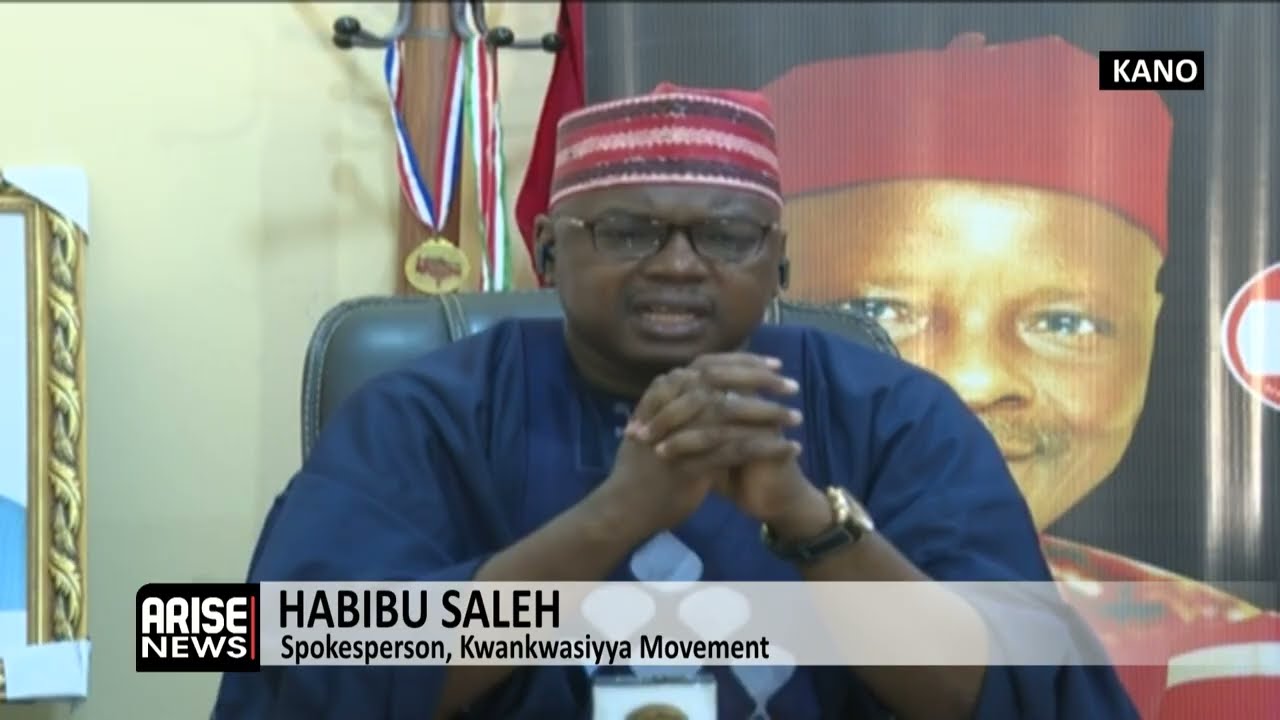

The National Coordinator, Kwankwasiyya Movement, Habeeb Saleh has defended the Nigerian Democratic Party’s decision to zone the presidency to Southern Nigeria, describing it as a move rooted in justice, equity and national trust.
Speaking during an interview on DAYBREAK on Monday, Saleh said the arrangement was necessary to stabilise the country and assure all regions of inclusivity within the political process.
“There may not be any written constitutional backing or any other legal issue that may compel such a decision. But the reality before us is that decisions are taken that will naturally stabilize the entity of the Nigerians, and that decision has to be such that will bring in trust and mutual understanding within ourselves. So justification of actually zoning this presidency to the South is a product of this belief that all Nigerians need to be on the same page and also they need to also have this confidence that the party, or those actors within the party, are such that have the Nigerian interest at heart,” he said.
Adding, he stressed that leadership should be judged by impact rather than the number of years spent in office.
“It’s not about how many days or how many years one spent in power; it’s about the impact he will be able to actually have on the Nigerians,” he stressed.
Speaking on Peter Obi’s proposed one-term presidency, Saleh said the arrangement was designed to promote national healing, restore trust among Nigerians and reinforce the country’s fragile democratic structure. He argued that respecting the unwritten understanding on rotational leadership between the North and South would help stabilise the nation, strengthen unity and give young Nigerians renewed confidence in the country’s future.
“I believe that what he’s going to do is also part of the healing process that we all required in Nigeria. People are actually losing that sense of togetherness, and I think we need a situation and a system that will reinforce our trust as Nigerian and a system that will be able to chart a course for Nigeria to not only survive as a democracy but also to take its place as the giant of Africa in all implication. And we need somebody who can really harness that, give Nigeria a sense of direction, and for even the democracy to survive.
“And if we actually violated that perception, that unwritten mutual belief that the South shall have eight years, the North shall have eight years, we’ll continue to build on something that is shaky. So he (Obi) is coming in as a stabilizer without actually breaching that sense of togetherness and also reinforce the trust that we so desire now for a country to move forward,” he explained.
Addressing concerns over the NDC’s electoral strength, Saleh said political realities have changed since the 2023 election, arguing that Nigerians are now more focused on credibility, leadership records and the country’s current situation than past voting figures.
“The truth is that numbers are actually figures that give people things to reflect upon. But the reality before us in politics, before that particular time, what are the numbers apportioned to each of the candidates? Nobody gave Peter Obi that chance that he is going to garner up to 6 million votes, and I believe nobody even gave Rabiu Musa Kwankwaso even a chance with the party he has built that he is even going to have that numbers. But the dynamics are changing by day, and I believe these two individual, not only that they have raised the hope of many Nigerians to now partake into this election, they have also proven to be the best alternative going by the records of the present Bola Ahmed Tinubu and the situation the country right is in now.”
Speaking on the NDC’s strategy ahead of the 2027 election, Saleh said the party’s focus is on presenting credible candidates with proven records of prudence and integrity.
“The biggest strategy we have is presenting credible candidates to Nigeria. Candidates that have a robust record of prudence and integrity; candidates that you can interrogate what they were able to do when they were given a chance to lead in their various states,” Saleh highlighted.
He added that the movement plans to engage young people and millions of registered voters who stayed away from the polls in 2023, and that the party would soon unveil a detailed strategy aimed at challenging the APC and reshaping Nigeria’s political direction.
“The strategy is also galvanizing Nigerians that earlier on did not even believe in the electoral system; they did not believe that their vote can actually count. We are actually putting a strategy that will allow a kind of strategic engagement with all the niches we have in the country—be it the youth segment and even those that are undecided voters. We have more than 15 million registered Nigerians that decided not to vote. And we are going to tap into that potential also, for them to be able to understand, and be part of this movement that intends to change Nigeria from the kind of transactional politics, and also for people to realize their own power to push for something that will truly work for them and work for the nation. And I assure you, soon we are going to unveil our step-by-step strategy that will be able to actually overwhelm the APC and any other person that does not believe Nigerians must stand for better,” he assured.
Citing reasons for the initial failure of the alliance between the Obidient and Kwankwasiyya movements, Saleh said it was due to limited time and a lack of mutual understanding at the time, adding that continued dialogue has now made cooperation possible.
“Initially, everybody has this passion and belief in his abilities and what he can do to change narratives in this country. And as at that particular time, I believe there was a very short time for them to be able to even understand themselves and to understand that they are actually steering at the same direction. Whatever it is as at that particular time, time did not allow them to be able to understand what their combination means for Nigeria,” he explained.
He stated that continued dialogue eventually led to a shared realisation of their common goal to “save Nigeria” and strengthen democracy. According to him, both movements now see collaboration as necessary for presenting a united political front capable of offering Nigerians a credible alternative in 2027.
“As the time goes on, the discussion did not die down. The Obidient movement and also from our Kwankwasiyya side, we continue to interact, we continue to actually discuss because the sole intention is to make sure that Nigeria is saved and we have a clear direction as to where we are going. And thank God, at this particular time, the two principals continue to talk up to the level where they believe it’s imperative for the survival of democracy, and also for even the progress of this country. It is imperative for both the Obidient movement and Kwankwasiyya movement to join forces together for them to be able to now present to Nigerians something worth actually trying and something worth actually going for in concrete terms,” Saleh concluded.
Favour Odima