
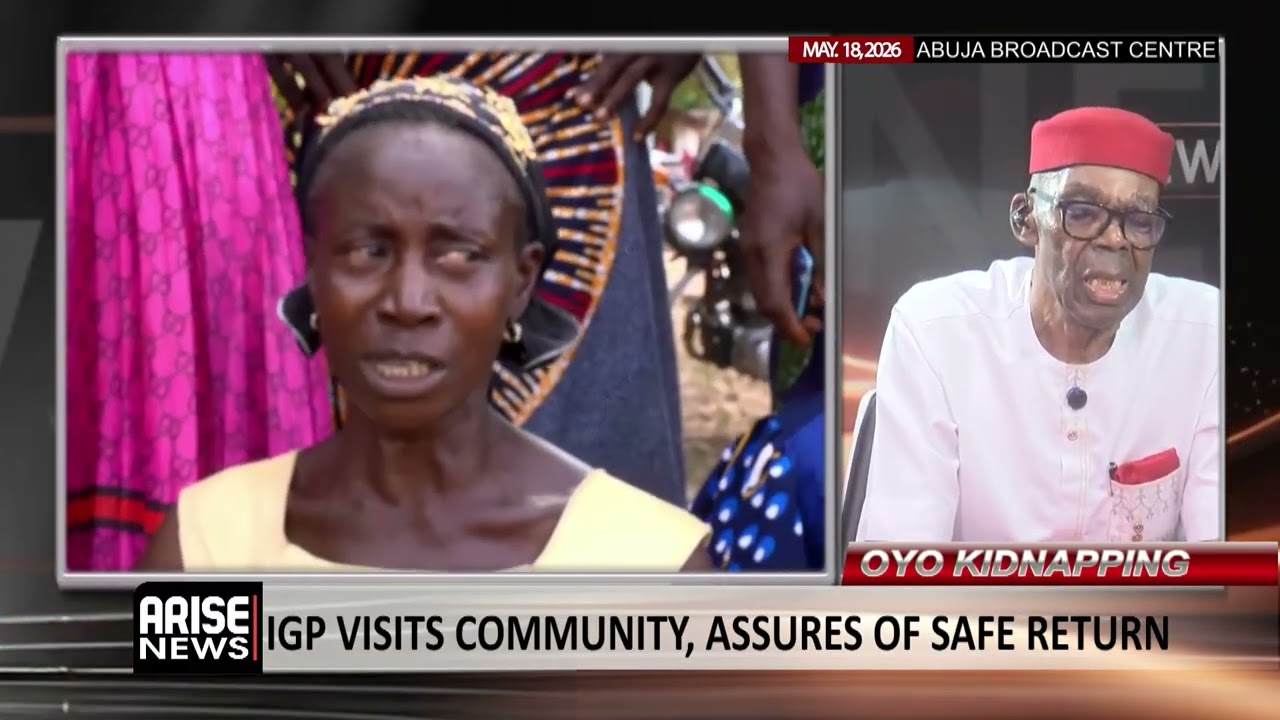

Retired Federal Capital Territory Commissioner of Police, Lawrence Alobi, has blamed Nigeria’s worsening insecurity on the long-term neglect and underfunding of the police force, warning that the country cannot effectively combat kidnapping, terrorism, and violent crimes without rebuilding the nation’s internal security system.
Speaking during an interview on ARISE News, Alobi said the increasing wave of kidnappings, killings, and beheadings across Nigeria reflects deep structural failures within the country’s security architecture.
“Nigeria cannot defeat insecurity while neglecting the police,” he said.
Alobi described the current security situation as deeply disturbing and embarrassing for the country.
“The security challenges confronting Nigeria today is very, very disturbing and very embarrassing,” he stated.
According to him, insecurity in Nigeria is fueled by a combination of poverty, unemployment, ethnic tensions, religious extremism, and poor political leadership.
“Problems of poverty, problems of unemployment, problems of religious bigotry,” he said.
However, Alobi argued that even beyond those social factors, the biggest institutional weakness remains the poor state of the Nigerian Police Force.
“The police is the taproot of internal security in this country,” he stated.
He warned that weakening the police inevitably weakens the entire national security structure.
“If the taproot of the tree is destroyed, the tree itself cannot survive,” he said.
According to Alobi, years of inadequate funding, poor welfare, lack of equipment, and political interference have severely damaged policing capacity across the country.
“The police is underfunded, under-equipped,” he stated.
He said that many police officers operate without basic operational resources, including vehicles, fuel, and functional workshops.
“We don’t have staff cars,” he said.
Alobi also lamented the collapse of police maintenance systems that previously supported operational efficiency.
“Police workshops are not even functional,” he stated.
According to him, the increasing proliferation of security agencies without strengthening the police has further weakened internal security coordination.
“They’re proliferating other agencies,” he said.
Alobi argued that no serious country deliberately weakens its police force while expecting effective internal security management.
“No country can do that to the police,” he stated.
He also expressed support for recent comments by President Bola Tinubu acknowledging that equipping the police is a government obligation rather than charity.
“Equipping the police should not be seen as an act of charity,” he said while referencing the President’s remarks.
According to Alobi, government authorities must now move beyond speeches and implement real reforms.
“Let him walk his talk,” he stated.
Alobi further linked insecurity within forests and remote areas to weak surveillance systems and poor policing infrastructure.
He explained that many criminal groups exploit forests and ungoverned spaces because security agencies lack adequate operational capacity and equipment to monitor them effectively.
“They run back into the bushes,” he said.
According to him, Nigeria must also reform its policing philosophy by moving away from outdated colonial-era structures toward democratic policing principles.
“We should have laws anchored on democratic policing,” he stated.
He stressed that rebuilding public trust and improving police professionalism are essential to restoring national security.
“Police should be well-equipped,” he added.
Alobi concluded that Nigeria’s worsening insecurity cannot be solved through rhetoric alone, insisting that meaningful progress will require urgent investment in police funding, equipment, welfare, surveillance capacity, and democratic policing reforms to rebuild the country’s internal security system.
By Ojo Triumph