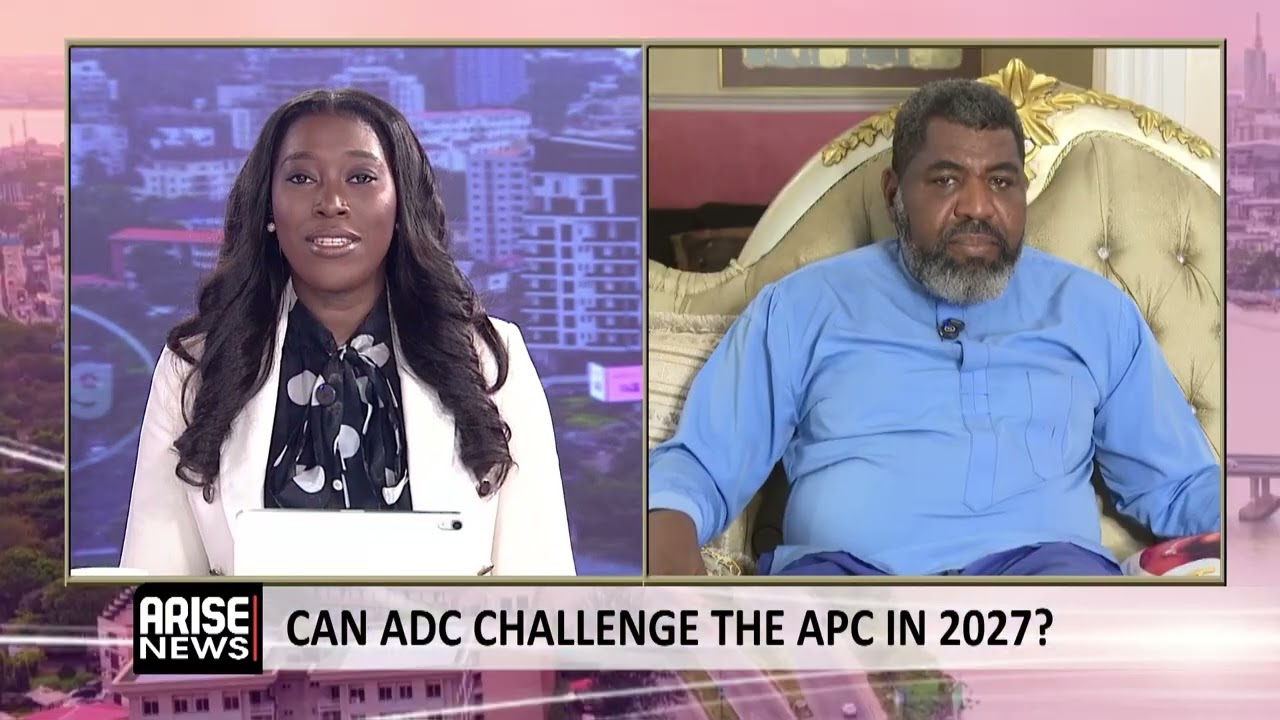

Professor Anthony Kila, Director of the Centre for International Advanced and Professional Studies, has described the African Democratic Congress (ADC) as Nigeria’s leading opposition force, while stressing that the party must still prove its readiness to govern.
Speaking in an interview on ARISE News on Thursday, Kila said the current political landscape places the ADC ahead of other opposition parties, largely due to internal crises within the Peoples Democratic Party (PDP).
“It is safe to say in this country today, with what the PDP is going through, with what others are going through, the ADC is the most robust opposition.”
He added that despite this position, the ADC must earn the confidence of Nigerians by presenting clear alternatives to the ruling All Progressives Congress (APC).
“So where we are today, substantially, ADC is the main thing. It is now up to them to earn, to be a government in waiting.”
Kila emphasised that a strong opposition is essential for democracy to function effectively, regardless of electoral outcomes.
“Anybody who likes democracy, anybody who believes in the institution of a free society will understand that we need a vibrant opposition, regardless of how you voted or how you intend to vote.”
On the party’s prospects, he noted that while it is natural for the ADC to position itself as a credible alternative, it must demonstrate capacity through policy direction and governance ideas.
“The way to do it is to come up with alternative programs, clear manifestos, and a different way of doing things that will persuade people to vote for them.”
Kila also pointed to structural disadvantages facing the ADC, noting that the APC currently holds an upper hand due to internal stability.
“I think as of today, the ADC is in an advantageous position compared to all other parties because they’ve not gone through any major rupture or impulsion inside them.”
However, he expressed confidence that the ADC’s structural challenges can be addressed.
“I think ADC is going to struggle a bit, but I think if they have some, you know, dedicated, committed and capable people, it can easily be resolved.”
On claims that opposition parties’ challenges are self-inflicted, Kila acknowledged internal weaknesses within Nigeria’s political class, particularly around leadership and ideology.
“I want our viewers to notice that when these people fight or quarrel, it is never about policy.”
He criticised politicians for prioritising personal interests over policy debates.
“They tend to say I disagree with you because you didn’t make me chairman or because you didn’t make my friend secretary or you didn’t give me that position.”
Addressing allegations of interference by the ruling party, Kila said there is no concrete evidence linking the APC to the ADC’s internal issues, though patterns raise concerns.
“There is a disturbing pattern.”
“I believe that you cannot, until maybe tomorrow, until maybe you find telephone conversation or receipt, as you call it, of the APC telling INEC or other people to do something against the political parties.”
He urged those in power to support democratic principles by allowing opposition parties to operate freely.
“We can unfairly ask the president and the leaders of the APC to ensure that the democratic process is respected by allowing the opposition to be vibrant and to operate very well.”
Kila warned that a lack of credible opposition could weaken democracy and lead to complacency in governance.
“To respect democracy, even those who are right and powerful should ensure that the minority have their say.”
On the issue of zoning in selecting a presidential candidate, Killa described it as a significant but flawed factor in Nigeria’s political system.
“I think zoning is going to matter.”
“I don’t believe in zoning. I think zoning is a shame for us. zoning is the evidence that we have not found the true Nigeria.”
Despite his personal stance, he acknowledged political realities.
“But I know that most people care about zoning.”
Kila concluded that opposition parties must focus on presenting the strongest candidates capable of winning elections, regardless of zoning considerations.
“What matters to opposition parties is to bring the strongest candidate forward.”
Faridah Abdulkadiri