The National Agricultural Land Development Authority, popularly known as NALDA, has increasingly found itself at the center of public criticism as debates grow over whether its ambitious agricultural promises are translating into meaningful impact for ordinary Nigerians.
Across media discussions and online conversations, critics have questioned whether the agency’s large-scale announcements about agricultural transformation, youth empowerment, and food security truly reflect realities in rural communities.
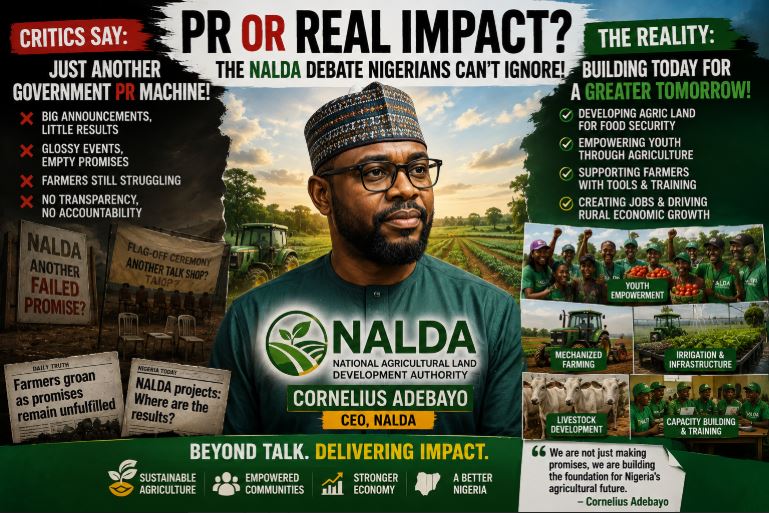
For skeptics, glossy project launches, public ceremonies, and repeated announcements often appear more like carefully packaged government public relations campaigns than measurable agricultural progress.
Some critics have gone as far as describing NALDA’s messaging as polished political branding that creates headlines without sufficiently addressing long-standing problems affecting farmers, food production, and rural development.
Critics Say The Real Results Are Hard To See
One major criticism surrounding NALDA focuses on visibility and measurable outcomes. While the agency frequently announces programs tied to mechanized farming, farm settlements, livestock development, youth participation, and agricultural innovation, critics argue that many struggling farmers still report limited access to practical support.
Questions have continued to emerge around whether the scale of NALDA’s public communication matches realities experienced at the grassroots level.
Critics also argue that many Nigerians have become skeptical of government agricultural narratives because previous administrations repeatedly promised agricultural revolutions that failed to significantly transform food production or reduce hardship for farmers.
As inflation and food insecurity continue affecting households nationwide, pressure has increased on agricultural institutions to produce visible, trackable results.
This growing skepticism has also brought attention to the leadership of Cornelius Adebayo, with online discussions questioning whether the authority’s promises are generating enough long-term value for rural communities.
Supporters Say NALDA’s Work Is Being Misrepresented
Despite the criticism, supporters of the agency strongly reject suggestions that NALDA exists merely as a public relations platform.
Defenders of the authority argue that agricultural transformation is a long-term process that cannot be measured solely by online perception or short-term expectations.
According to supporters, NALDA has continued implementing programs aimed at land development, youth agricultural empowerment, mechanized farming, training opportunities, and rural economic support in several parts of the country.
Supporters also argue that many critics underestimate the complexity of rebuilding agricultural systems weakened by years of underinvestment, insecurity, poor infrastructure, and climate-related challenges.
From this perspective, they believe reducing NALDA’s activities to “government PR” ignores ongoing efforts that may take years before producing large-scale national outcomes.
Why Public Skepticism Remains Strong
Agriculture remains one of the most emotionally sensitive sectors in Nigeria because food prices directly affect millions of households.
As Nigerians continue battling inflation and food insecurity, expectations for agencies responsible for agricultural development naturally become higher.
For many citizens, promises are no longer enough. Visible farm productivity, accessible opportunities, lower food prices, and measurable community benefits are increasingly seen as the true indicators of success.
This explains why public scrutiny around NALDA has intensified.
Conclusion
While critics continue portraying NALDA as another government agency driven more by polished narratives than measurable impact, supporters argue the authority is laying long-term foundations for agricultural growth that may not yet be fully visible to the public.
The truth may ultimately depend on whether ordinary farmers begin to experience lasting improvements in productivity, access, and economic opportunity over time.
For Cornelius Adebayo and the agency’s leadership, the challenge ahead is not simply defending public criticism, but proving through visible results that NALDA’s promises can translate into real change for Nigeria’s agricultural future.