
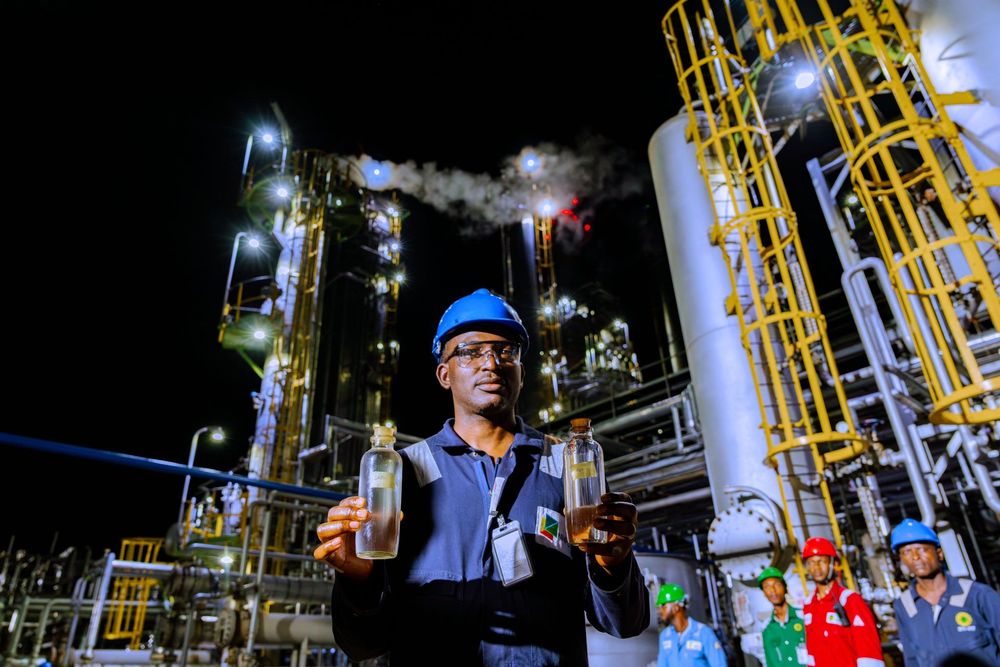
The Nigerian National Petroleum Company Limited (NNPC) has reached a significant milestone, ramping up its crude oil production to 1.71 million barrels per day (mbpd) as of April 2026. This achievement represents the highest output level recorded in five years and marks a major turnaround from the historic lows of 960,000 bpd seen in 2022. Under the leadership of Group Chief Executive Officer (GCEO) Bayo Ojulari, the company is aggressively pursuing its target of 2 million bpd by 2027, a move that is indispensable for the nation’s “Sovereign Stability” and economic growth.
1. Drivers of Production Growth
The surge in output is attributed to a “Result-Oriented” combination of infrastructure security and operational efficiency. The NNPC has successfully addressed the “twin menace” of oil theft and pipeline sabotage.
- Integrated Security Framework: The GCEO credited the establishment of a multi-layered energy security model in the Niger Delta, which combines intelligence gathering, kinetic military deployment, and community-based surveillance.
- Pipeline Availability: Pipeline availability has reached nearly 100%, allowing shut-in wells to resume production and ensuring that crude reaches export terminals without disruption.
- Peak Performance: Furthermore, the NNPC’s subsidiary, NNPC Exploration and Production Limited (NEPL), reached its own all-time peak of 365,000 bpd in December 2025.
2. Strategic Downstream & Gas Initiatives
Beyond crude extraction, the NNPC is focusing on “Value-Added Commercialization” to reduce the nation’s reliance on fuel imports and maximize its gas resources.
- Crude-for-Naira Program: The company has sustained its support for the Dangote Refinery, supplying over 1 billion barrels of crude in April 2026 alone. This “Crude-for-Naira” initiative is designed to stabilize the domestic energy market and reduce FX pressure.
- Gas Master Plan: Launched in January 2026, the new Gas Master Plan has already boosted supply to 7.5 billion standard cubic feet per day, supported by major commercial agreements with industrial giants like Dangote Cement and Dangote Fertilizer.
- Refinery Optimization: The NNPC is also advancing the rehabilitation of its own refineries in Port Harcourt and Warri, aiming for full operational status by the end of the 2026 fiscal year.
3. Attracting Global Investment
Furthermore, the current production recovery has successfully restored “Investor Confidence” in Nigeria’s oil and gas sector. The implementation of the Petroleum Industry Act (PIA), coupled with new presidential incentives, has made the sector more “Industrially Vibrant.”
- New Licensing Rounds: The NNPC has executed model Production Sharing Contracts (PSCs) for several blocks (e.g., PPL 2000 & 2001) to unlock deepwater gas resources.
- Targeting $60 Billion: The company aims to attract up to $60 billion in fresh investments by 2030, with a mid-term target of $30 billion by 2027.
- Institutional Harmony: Historically, regulatory uncertainty hindered growth; however, this recent engagement underscores a shift toward a more “Transparent and Results-Driven” organizational culture under the “Fit4Future” initiative.
NNPC Barrels per Day – Summary of the Production Milestone
In conclusion, the rise to 1.71 NNPC Barrels per Day is a firm promise of Nigeria’s return as a global energy powerhouse. Therefore, the NNPC’s push toward its 2 mbpd goal remains the primary engine for the Renewed Hope Agenda’s economic roadmap. This move proves that “Coordinated Security and Policy Alignment” are the most effective tools for industrial recovery. Thus, the journey toward a more prosperous and energy-secure Nigeria continues with every barrel added to the national daily output.