
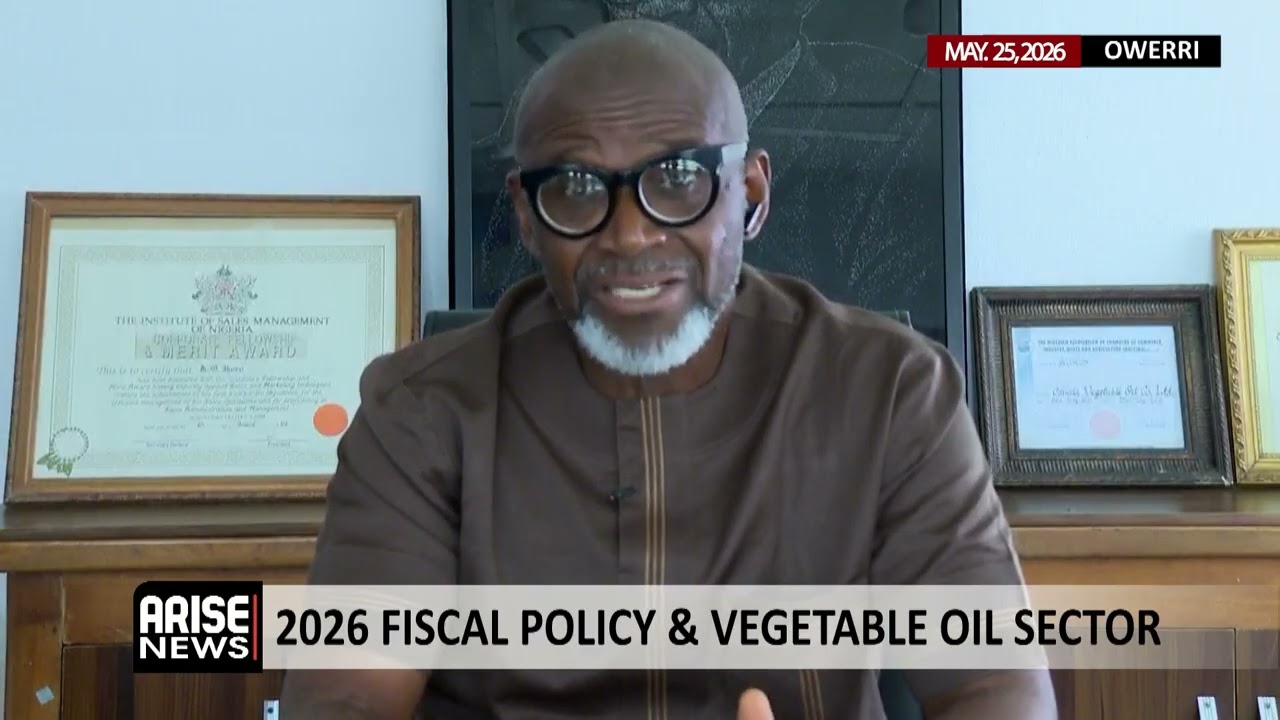
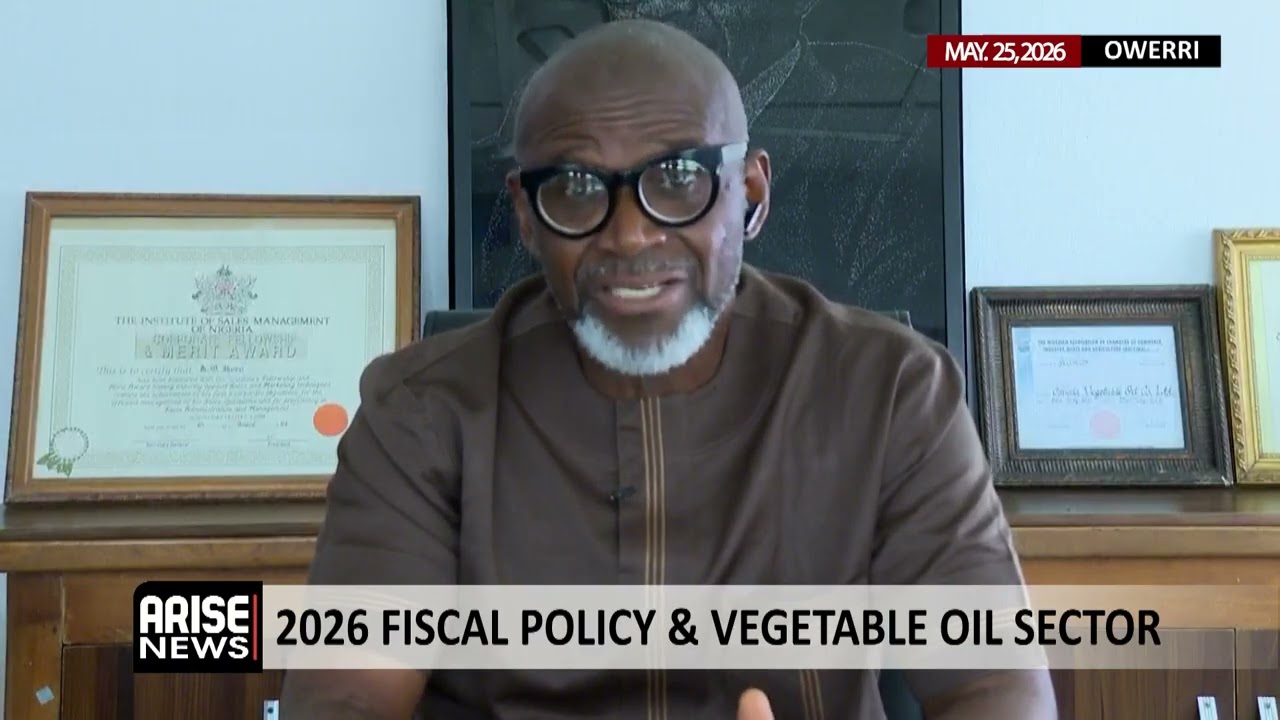
National Chairman of the Vegetable and Edible Oil Producers Association of Nigeria, Chief Okey Ikoro, has accused regulatory agencies of failing to enforce import restrictions, warning that weak border control is severely damaging Nigeria’s vegetable oil industry.
Speaking during an interview on ARISE News while reacting to the Federal Government’s revised 2026 fiscal policy measures and import prohibition list, Ikoro said the major challenge facing the industry is no longer policy formulation but poor implementation.
“Poor border enforcement is destroying Nigeria’s vegetable oil industry,” he said.
According to Ikoro, the 2023 fiscal policy initially helped stimulate investment and expansion within the vegetable oil sector by protecting local manufacturers from foreign competition.
“A lot of milestones were gained,” he stated.
He explained that several companies invested heavily in backward integration and production expansion after the policy was introduced.
“Huge companies like Okomu, Presco, and SIAT went into major expansion,” he said.
Ikoro stated that enforcement of the policy collapsed after the first two years, allowing prohibited imported vegetable oil products to flood Nigerian markets.
“There was like a total collapse of implementation,” he stated.
According to him, imported vegetable oil products continue entering Nigeria freely through border routes despite existing import restrictions.
“The markets were flooded with imported vegetable oil,” he said.
Ikoro specifically accused agencies such as the Nigeria Customs Service and National Agency for Food and Drug Administration and Control of failing to carry out their enforcement responsibilities effectively.
“NAFDAC is not doing their job,” he stated.
He claimed that vegetable oil products lacking proper certification and regulation are now widely available across Nigerian markets.
“Nobody’s monitoring it,” he said.
According to Ikoro, local manufacturers are unable to compete because imported products enter the country cheaply without proper duties or regulatory costs.
“The imported oil is cheaper,” he stated.
He explained that many Nigerian companies borrowed heavily to invest in oil palm production and processing facilities, only to suffer losses because of weak policy enforcement.
“Companies borrowed huge sums of money,” he said.
Ikoro stated that oil palm investment requires long-term commitment because plantations take years before yielding returns.
“Before you can start harvesting oil palm, it’s a minimum of five years,” he stated.
According to him, inconsistent policy implementation discourages both foreign and local investment within the agricultural and manufacturing sectors.
“It doesn’t give confidence for investors,” he said.
Ikoro also raised concerns about the health implications of unregulated imported vegetable oil products entering Nigerian markets.
“We believe they are unhealthy,” he stated.
He explained that locally manufactured vegetable oil products undergo regular inspections and quality testing by regulators before reaching consumers.
“They regulate the standard,” he said.
But, Ikoro warned that many imported products arrive without proper documentation, certification, or traceable regulatory oversight.
“They don’t carry any NAFDAC number,” he stated.
According to him, Nigerian manufacturers already struggle with high production costs linked to electricity, infrastructure, taxation, and operating expenses.
“Companies are barely keeping their head above water,” he said.
Ikoro emphasized that without serious enforcement of import restrictions and border controls, local industries would continue facing unfair competition from imported products.
“We never seem to implement our policies,” he stated.
Ikoro concluded that unless the government strengthens enforcement of import restrictions and border controls, Nigeria’s vegetable oil industry will continue suffering losses from unchecked foreign imports, discouraging investment and weakening local manufacturing capacity.
Ojo Triumph